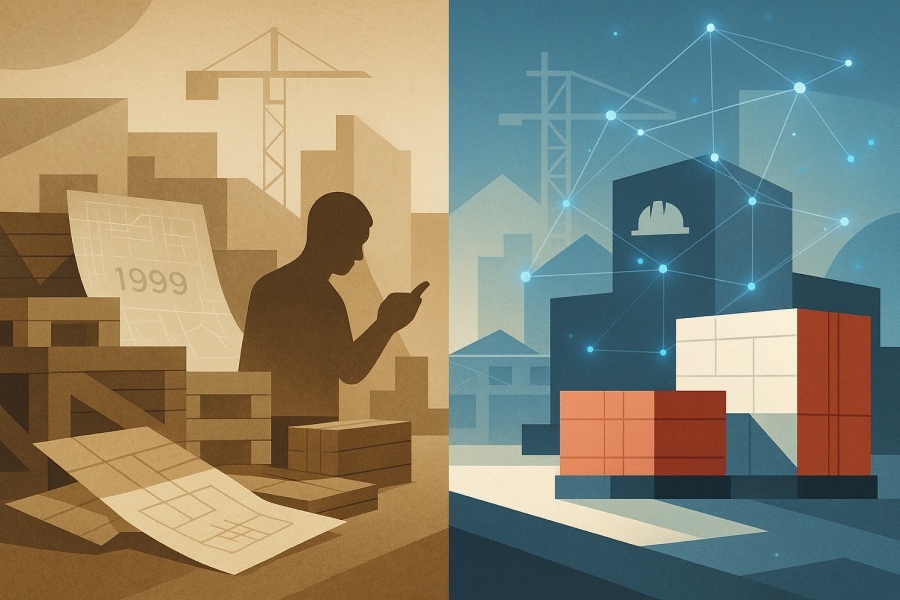

Capital isn’t the problem. Projects aren’t the problem.
The problem is bodies.
Over the next decade, the U.S. will need roughly 650,000-725,000 construction and extraction workers every year just to fill open roles and replace people retiring or leaving the industry.
That’s not to grow capacity. That’s just to keep the lights on.
At the same time, demand is tilting toward the most labor-hungry, skill-intensive projects the industry has ever seen:
- AI-driven data centers.
- Grid and transmission buildouts.
- Clean-energy and storage projects.
- Semiconductor fabs and advanced manufacturing.
- Plus, the unfinished business of housing and traditional infrastructure.
In 2026, those curves intersect: an aging workforce, a smaller pipeline of young workers and a wall of megaprojects all competing for the same electricians, linemen, pipefitters and supers.
There’s no plausible hiring plan that closes that gap.
That’s why 2026 isn’t just going to be “another busy year.” It’s the start of what you could call the efficiency mandate: If each worker isn’t effectively doing the work of 1.2-1.5 traditional workers — without burning out — projects will slip, get de-scoped or never break ground.
This is what that means in practice.
Why is the labor problem structural, not just “a hot cycle”?
This isn’t just another tight market that will ease after a rate cycle. Structural forces — demographics, replacement needs, immigration dependence and a thin pipeline of young workers — mean the industry is running out of experienced people faster than it can bring new ones in. That imbalance defines the next decade.
Is this different from every other “skilled labor shortage” headline you’ve seen for 30 years?
Yes. For a few reasons.
Replacement demand dwarfs new job growth
U.S. construction employment today sits around 8.3 million workers, including roughly 3.4 million in residential. The raw growth story doesn’t look explosive; the Bureau of Labor Statistics (BLS) projects only single-digit percentage job growth over the next decade.
But that’s not the real issue.
The real issue is replacement demand:
- The BLS expects about 650,000 openings per year in construction and extraction roles through the mid-2030s, mostly to replace people retiring or leaving the occupation.
- NAHB/HBI’s labor market analysis pegs it even higher: around 723,000 construction occupational openings per year right now, implying more than 2.1 million hires needed just in 2024-26.
- ABC’s modeling says the industry needed about 500,000 additional workers in 2024, and a similar order of magnitude in 2025-26, on top of those replacement needs.
The math is simple and ugly: Replacing today’s workforce is a much bigger job than adding new positions.
“Openings are down” is not the good news it sounds like
If you look at job openings data, you’ll see a story that, at first glance, looks like relief. Open construction job postings have fallen from roughly 375,000 in mid-2024 to about 245,000 in mid-2025. That’s a big drop. It’s also misleading.
At the same time:
- Overall construction employment remains near record highs.
- The unemployment rate in construction is hovering near historic lows.
- National contractor surveys still show 70-80% of firms struggling to fill hourly craft roles, especially in mechanical, electrical and civil trades.
In other words, we’re close to full employment for skilled craft labor. Openings are dropping not because there’s suddenly plenty of talent, but because many contractors are posting fewer jobs they know they can’t fill and stretching the people they have.
Demographics are destiny
The age profile is even more telling:
- More than 1 in 5 construction workers are 55 or older, a share that has nearly doubled since the early 2000s.
- Various workforce studies estimate 30-40% of today’s construction workforce will retire or age out over the next decade.
- Only a small slice of workers — about 1 in 10 — are under 25, and the pipeline of new entrants is nowhere near large enough to backfill what’s leaving.
These aren’t interchangeable heads, either. The workers retiring are often your most experienced supers, foremen and specialist trades. When they walk off the job for the last time, you don’t just lose a pair of hands; you lose institutional memory and productivity that took decades to build.
Immigration is the quiet keystone
On top of that, construction is highly dependent on immigrant labor:
- Immigrants make up roughly 25-30% of construction workers nationally.
- In key trades — roofers, drywallers, laborers, carpenters — immigrants account for a third to more than half of the workforce in many markets.
- In states like California and Texas and fast-growing metros, those shares are even higher.
Any tightening or uncertainty in immigration policy isn’t an abstract political debate for this industry but directly caps the maximum achievable headcount, especially in the trades that already feel tightest.
Put all that together and you get a simple conclusion: This isn’t just a hot cycle where “we’ll hire once rates fall.” The constraint is structural and baked into demographics and policy for the next decade.
How are four megacycles colliding over one shared talent pool?
Over the next several years, multiple policy- and technology-driven buildouts hit at once: data centers, grid upgrades, clean energy and advanced manufacturing. Each needs overlapping trades in overlapping regions. Instead of balanced cycles, contractors face stacked megacycles that all pull from the same shallow talent pool at the same time.
If the labor side of the equation weren’t bad enough, look at what’s arriving on the demand side.
1. Data centers and AI’s power appetite
You don’t need to be in the tech world to feel the ripple effects of AI. Data centers already used about 176 TWh of electricity in 2023, roughly 4.4% of total U.S. power demand. Updated federal and independent studies now project that number could reach 325-580 TWh by 2028, or 6.7-12% of total U.S. demand.
Private-sector forecasts like Goldman Sachs are even more aggressive, projecting data centers could hit about 8% of U.S. power demand by 2030 and require tens of gigawatts of new generation capacity.
All of that must be designed, permitted and built:
- Hyperscale and colocation campuses
- Substations, high-voltage lines and interconnections
- Cooling infrastructure and high-density MEP systems
- Supporting roads, water and utilities
These are complex, coordination-heavy projects with intense demands on mechanical, electrical and civil trades.
2. Grid modernization and transmission
At the same time, the grid those data centers rely on is being rebuilt in real time. The U.S. Department of Energy’s transmission needs analysis concludes that to meet reliability and clean-energy goals, the country must effectively double regional transmission capacity and increase interregional transfer capacity fivefold by 2035.
That translates into:
- Tens of thousands of new line miles over the next decade
- Hundreds of billions of dollars in capital expenditures
- Thousands of substations, towers, foundations and associated civil work
Federal programs are already moving money: multibillion-dollar grid resilience grants, transmission facilitation loans and direct federal support for marquee lines. Those aren’t hypothetical white papers; they’re construction pipelines.
3. Clean energy and storage
Then layer in the clean energy buildout: utility-scale solar, onshore and offshore wind, storage, hydrogen hubs and more.
Analysts tracking the Inflation Reduction Act estimate:
- Hundreds of new clean energy projects announced in its first couple of years.
- Hundreds of thousands of construction job years generated during buildout alone.
Again, these need line workers, civil crews, steelworkers, electricians and commissioning specialists — the same people AI data centers and the grid are trying to hire.
4. Semiconductors and advanced manufacturing
Finally, there’s the semiconductor wave. CHIPS-backed fabs in Arizona, New York, Texas and Ohio are already confronting labor shortages severe enough to delay timelines. We’ve seen:
- High-profile fabs pushing production dates out by several years.
- Public commentary from project sponsors citing a lack of skilled construction workers, especially for high-purity process piping, power distribution and controls.
Fab projects, like data centers, demand the best of the best: highly experienced mechanical, electrical and process trades, plus tight QA/QC and commissioning.
Now put all four together: data centers, grid, clean energy, fabs — plus ongoing housing and infrastructure backlogs. They all want the same people, in the same timeframe, often in the same regions.
That’s the 2026-30 collision.
Why doesn’t “just pay more” solve the labor crunch?
Raising wages helps but can’t overcome time, geography and policy. Apprenticeships still take years, workers can’t instantly relocate to every hot market and immigration rules sit outside contractors’ control. Compensation becomes table stakes, not a silver bullet, in a market where the total pool of skilled labor is capped.
In a textbook market, high demand and short supply should mean one thing: Pay more. Problem solved. Reality isn’t that simple.
Yes, wages have moved:
- Construction wages have grown faster than the overall economy since the pandemic.
- Some trades have seen double-digit percentage increases in just a few years.
- Contractors are offering hiring bonuses, retention perks and more training.
And yet the shortages persist, for reasons that aren’t fixable with a line item in a budget:
- Training takes time: You don’t turn a new hire into a journeyman electrician in 18 months, no matter what you pay.
- Work is geographically sticky: Projects don’t neatly line up where the workers are. Convincing specialized trades to move across the country at scale is slow and expensive.
- Immigration policy is out of contractors’ control: The industry can’t unilaterally expand the pool of eligible workers.
There are also early signs of cooling in a few regions — more applicants here, fewer job openings there — but that’s cyclical noise on top of a structural trend. If your plan is simply “we’ll pay up when things get tight,” you’re already behind.
How are rework and bad data draining hidden capacity?
Even before the crunch peaks, many projects effectively operate with smaller crews than they think. Time lost to rework, poor information flow and mismatched documents quietly burns a double-digit share of available hours. In a world where new people are scarce, recovering that wasted capacity becomes existential.
Even with today’s workforce, the industry is leaving a massive amount of capacity on the table.
Productivity has flatlined
Global construction productivity has grown at about 1% per year over the past two decades — roughly one-third the rate of manufacturing and well below the broader economy. In many advanced economies, including the U.S., construction labor productivity has stagnated or declined since 2000.
That would be annoying in a balanced market. In a market with structural labor tightness, it’s lethal.
Rework is a phantom workforce
Look at rework and bad data:
- Rework alone is estimated to account for around 5% of U.S. construction spending, or tens of billions of dollars a year.
- Studies tying cost overruns to data problems estimate that bad data and communication failures drive well into the triple-digit billions in avoidable cost annually, globally.
- Field and office staff regularly report losing a full workday every week to low-value tasks like searching for information, reconciling versions and clarifying miscommunications.
Translate that into people: If an average project team is losing 10-20% of its time to rework, hunting for documents or fixing coordination errors, that’s the equivalent of phantom crews you’re paying for but not actually getting. In a world where you can’t conjure up an extra 10% headcount, the only rational move is to stop wasting the 10% you already have.
What does the efficiency mandate look like in practice?
The efficiency mandate is less about heroic overtime and more about redesigning how work flows. Firms that standardize, digitize and industrialize — through BIM, coordination, prefab and lean planning — unlock more value from every hour on site. Those choices determine who can still deliver complex work when the talent pool tightens.
“Be more efficient” is meaningless. The question is: How? The data and the leading case studies point to a clear answer: standardized, digital, industrialized workflows that unlock more output per worker without asking people to simply sprint harder.
BIM and model-based coordination
When BIM is used consistently — not as a one-off experiment — contractors report:
- Dramatic reductions in clashes and RFIs
- Fewer constructability problems in the field
- Lower defect rates at handover
- More predictable schedules
That is pure capacity. Less time fixing what shouldn’t have been built in the first place means more time building what matters.
Prefabrication and modular
Industrialized construction isn’t theoretical anymore. On the right types of projects, the numbers are well established:
- 20-50% faster delivery for suitable projects.
- Up to 20% cost reductions in some modular case studies.
- Hospital projects that moved more than 150,000 work hours off site, cut more than two months from the schedule and still reduced overall cost once you count rework and safety benefits.
- Data center and health care jobs where 70% of complex piping or MEP assemblies were prefabricated, shrinking onsite headcount and congestion.
Again: That’s what making each worker “count for more” looks like in the real world.
Lean/IPD and digital planning
Lean construction and integrated project delivery aren’t just management buzzwords. In projects where they’re taken seriously, documented results include:
- Schedules 30% faster than traditional delivery
- Double-digit reductions in total labor hours
- Lower peak onsite crew counts
- Higher safety performance
When pull planning and Last Planner systems move from sticky notes on a trailer wall to digital environments tied to actual model and schedule data, those gains become repeatable instead of a one-off success story.
Put it all together and you get the heart of the efficiency mandate: Firms that combine BIM, prefab, lean/IPD and structured data can realistically get 1.2-1.5 times the effective output per worker on complex projects. In a structurally tight labor market, that isn’t a nice differentiator. It’s survival.
How should construction really think about automation and AI?
Robotics and AI are best understood as amplifiers sitting on top of strong digital foundations, not magical replacements for crews. Where data is clean and scopes are repetitive, they can meaningfully shift labor curves. Where workflows are messy, they mostly expose underlying problems instead of solving them.
Then there’s the current obsession: robotics and AI. They matter. But not in the way the marketing suggests.
Where robotics is paying off
Real projects — not glossy concept videos — show robotics moving the needle in specific scopes:
- Rebar-tying robots cutting the schedule for a bridge deck scope roughly in half.
- Layout robots that not only increase layout speed but drive better upstream coordination, leading to measurable profit improvements.
- Autonomous or semi-autonomous scanning robots walking jobsites at night, feeding reality capture data into BIM and progress-tracking tools.
The pattern: Robots do well on repetitive, physically demanding tasks where there’s a strong digital model and clear tolerances.
Where the hype runs into the wall
You don’t hear as much about the pilots that stall out. But they’re common:
- Robots that outperform humans on a per-day drilling metric but require so much BIM prep and coordination that net productivity is barely better — or worse.
- Firms excited by robotics on paper, but unable to justify scaling beyond pilots because ROI is fuzzy and site teams weren’t brought in early.
- Vendors that disappear or fail to integrate with existing systems, leaving contractors burned.
Survey data is telling: Optimism about construction robotics is high, but actual adoption has dipped in some studies, as contractors pull back to a smaller number of well-chosen use cases instead of chasing every new demo.
AI as a force multiplier for knowledge work
AI is already proving its worth in less glamorous but more fundamental ways:
- Progress tracking: comparing 3D scans to BIM to automatically flag deviations, delays and billing issues — something that would otherwise soak up scarce VDC staff.
- Predictive scheduling: using historical performance, weather and resource data to surface likely schedule risks weeks before a human would see them.
- Estimating and document search: reducing the time preconstruction and field teams spend digging through drawings, RFIs and emails to figure out what’s current and what’s not.
- Safety and quality monitoring: computer vision systems that spot PPE noncompliance or installation defects at scale.
The common denominator is obvious: None of this works without clean, standardized, current project data. AI doesn’t rescue bad workflows; it amplifies whatever you feed it.
How are leading builders already closing the efficiency gap?
Large builders are already operating on a blunt assumption: they can’t simply hire their way through the next decade.
Instead, they’re quietly redesigning how work gets delivered. That means shifting hours offsite, tightening coordination through BIM, standardizing data environments and focusing automation on a small number of high leverage use cases that move schedules and margins. Their project results offer a preview of what’s becoming the new baseline.
If all this still sounds theoretical, look at what’s happening on the industry’s most complex work:
- On large, multi-building data center campuses and similarly fast-moving programs, leading builders are increasingly leaning on scan-versus-BIM comparison and AI-assisted deviation detection to maintain quality and schedule when internal VDC capacity can’t keep pace with field progress.
- Automated reality capture handles monotonous documentation, allowing superintendents and project engineers to focus on coordination and problem-solving instead of clerical work. In preconstruction, AI-assisted estimating and standardized data environments are reducing friction and compressing timelines before crews ever mobilize.
The motivation isn’t trend-chasing but structural. These firms can’t simply triple their VDC staff or double their superintendent bench.
The same logic shows up in how industrialized construction is being applied across data centers, health care and hospitality.
Multi-trade prefabrication is shaving weeks off schedules. Hundreds of thousands of labor hours are being shifted offsite, reducing peak headcount, congestion and safety exposure. Volumetric modular systems are delivering finished components faster and with far less onsite disruption.
Again, the through-line is clear: when you can’t find more labor, you change where and how the work happens.
On major infrastructure and complex building projects, builders are also combining lean delivery models, BIM and digital twins to tighten feedback loops between design and construction. By continuously comparing as-built conditions to design intent using drones, sensors and model-based workflows, teams are reducing rework, improving material efficiency and compressing project durations without adding headcount.
Why isn’t this pure doom — and what’s still different this time?
Short-term signals can be confusing — local slowdowns, softer openings data, mixed technology results — but they sit on top of deeper trends that don’t reverse quickly. Leaders must read both layers at once: acknowledge regional cooling where it exists without mistaking it for a return to the old, labor-abundant normal.
To be fair, there are countersignals:
- Some regions report that hiring is getting slightly easier.
- Job openings are off their peaks.
- A few robotics pilots have underwhelmed or been shelved.
- Forecasts for AI and data center power demand vary widely, with some scenarios showing slower growth if efficiency improves.
All true.
But those nuances don’t change the underlying structural picture:
- Demographics point one way.
- Policy-driven capital expenditures (CHIPS, IRA, infrastructure) are already committed.
- Data center and grid projects in the 2026-30 window are locked into the pipeline.
You might get temporary pockets of relief. You won’t get a return to the world where you could always solve problems by “adding a few more workers.”
What hard choices does 2026 force construction leaders to make?
As projects and people diverge, 2026 becomes a forcing function. Owners, general contractors and trades all must decide whether they will privilege partners and practices that create capacity — through digital coordination, prefab and smarter planning — or hope the market loosens. Those choices shape who can even bid certain work.
In 2026, the stories you tell yourself about staffing will collide with reality. Practically, that means a few hard choices.
If you’re an owner or developer
You can’t just pick the lowest bidder and assume they’ll “figure it out.” You need to ask:
- How standardized and digital are their workflows?
- How do they handle coordination, rework and data?
- Can they realistically staff this project in this market, or are they gambling?
Soft factors like BIM maturity and prefab capability are now directly tied to your schedule and risk profile.
If you’re a GC or EPC
You must decide whether you’re going to be a capacity creator or a capacity victim. That means:
- Treating BIM, structured data and digital collaboration as core operations, not side projects.
- Identifying where prefab and modular can be standard practice, not an exception.
- Choosing a small number of automation and AI use cases tied to real bottlenecks — progress tracking, scheduling, layout, documentation — and doing the change management to scale them.
- Investing in training so your people can operate confidently in this environment.
The firms that do this will bid — and deliver — projects their competitors literally can’t staff.
If you’re a trade contractor
Your choice is stark:
- Become the partner who can integrate with model-based workflows, prefab assemblies and digital QA/QC, or
- Become the shop that only makes sense on smaller, less time-sensitive work.
There’s a lot of business in both lanes. But you can’t pretend they’re the same.
Where does Bluebeam fit in the efficiency mandate?
Bluebeam doesn’t manufacture robots or design fabs; it quietly shapes how information moves. When drawings, markups and reviews live in a single, structured environment, teams waste less time chasing clarity and fixing preventable errors. That document layer is often the fastest, least disruptive way to unlock real capacity.
None of this is about a single tool solving a structural problem. The firms winning the efficiency game are doing it with systems: people, process, data and technology working together.
But if you strip away the buzzwords, a few foundational needs show up repeatedly:
- Teams need clean, current documents everyone trusts.
- They need standardized markups, layer conventions and workflows so data can be reused — not recreated — across scopes and phases.
- They need fast, transparent review cycles that don’t leave junior staff guessing which version is “real.”
- They need digital guardrails that help a less experienced engineer, coordinator or foreman perform closer to how a veteran would.
That’s where a platform like Bluebeam sits: not as the robot or the AI “brain,” but as the collaboration and data-quality layer that makes those bigger moves possible.
If rework and bad data are burning the equivalent of whole crews off your projects, then tightening up how drawings are shared, reviewed, marked up and standardized is one of the fastest ways to create capacity without hiring a single extra person.
What’s the bottom line for construction in 2026 and beyond?
The industry isn’t running out of projects or capital; it’s running out of time and people. Firms that treat efficiency as a strategic mandate — re-engineering how they coordinate, document and deliver work — will still have room to grow. Everyone else will find that the real constraint is no longer negotiable.
In 2026, the industry’s binding constraint isn’t going to be money. It isn’t going to be projects.
It’s going to be people.
You won’t hire your way through a decade where:
- A third or more of your workforce retires.
- Immigration inflows are uncertain.
- Data centers, the grid, clean energy and fabs are all demanding the same scarce trades you need.
The only lever left with enough throw is efficiency — real, structural efficiency, not just working longer hours. The companies that treat 2026-30 as an efficiency mandate — and industrialize how they plan, coordinate and build — will get to say yes to the best projects and deliver them.
Everyone else will be stuck bidding work they can’t reliably staff.