Across Mumbai’s construction sites, mornings begin the same way: the mukkadam is already doing math.
Not the kind they teach at IIT. The kind where you calculate how many workers you can move, how much material you can receive and how many minutes you have before the city wakes up and shuts the whole operation down. This scene — reconstructed from research on Mumbai’s construction economy — repeats itself thousands of times a day across the city.
The Bombay High Court says Mumbai’s citizens have a right to sleep. The traffic police say heavy goods vehicles are off the road by 7 a.m. The construction window — for one of the most complex urban rebuild programs on the planet — is maybe five hours long.
Somewhere under the mukkadam’s feet, a tunnel is being finished. Workers earning 615 rupees a day bored through coastal soft clay and 100-year-old colonial water mains to build a metro line that will move 1.6 million people.
Those workers won’t be riding it. They’ll pack up camp and follow the next job to the next neighborhood. The city will absorb what they built, appreciate around it and move on.
This is how Mumbai builds. Not by design. Because it couldn’t be stopped from becoming this.
Trapped on a Sinking Peninsula with Nowhere to Go
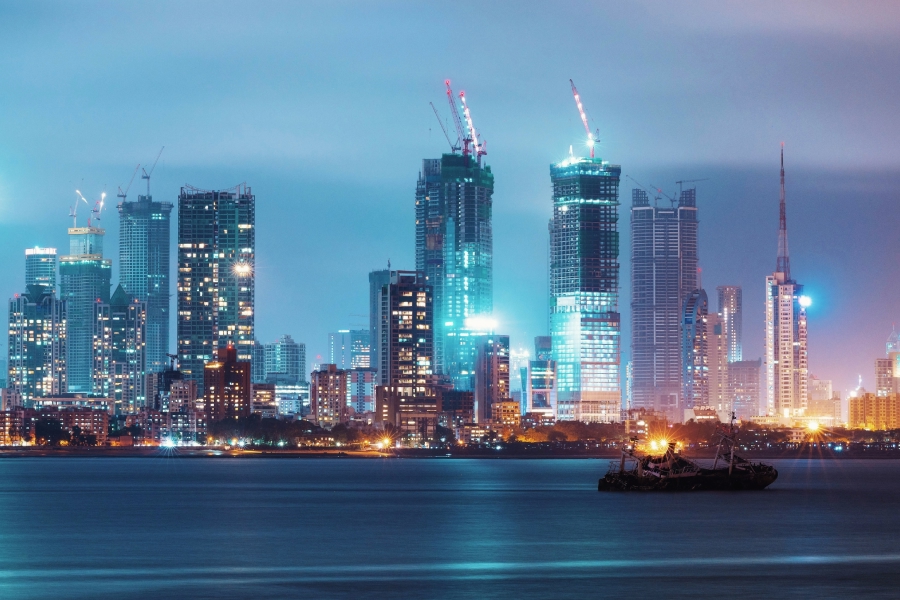
The city was built on seven islands stitched together over two centuries of British land reclamation. What you get is a 67-kilometer peninsula — Arabian Sea on one side, Thane Creek on the other — with roughly 22 million people on it and nowhere to expand.
The answer so far: go up. Go inward. Which sounds simple until you’re standing on ground that’s sinking 2 millimeters per year, mostly below the high-water mark, in a city where more than 60% of the population lives in flood-prone wards.
The grand vision is what officials call the “45- to 60-minute city” — knitting this impossible geography together with bridges, tunnels and metro lines fast enough that the whole thing holds. Whether the geology cooperates is a different question.
The Underground Bet That Actually Paid Off
The Aqua Line — Metro Line 3 — is 33.5 kilometers of fully underground metro connecting South Mumbai’s financial district to the northern hubs where the offices and airport are. Going elevated would have meant demolishing thousands of historic structures. So, they went deeper.
Originally budgeted at 23,136 crore rupees in 2011, the final cost reached roughly 37,000 crore rupees — a 60% overrun. It cut a 90-minute commute to 30. Property values near its 27 stations are up 10% to 40% by industry estimates. It is, straight up, an infrastructure achievement that deserves to be called that.
The part nobody talks about: the workers who built it can’t afford to live within 30 kilometers of it. That’s not a critique of the metro, but a fact about the city the metro was built to serve.
The $1 Billion Economy the City Wants to Tear Down
Dharavi sits in the heart of Mumbai — low-rise, dense, inadequate sanitation, fire risk in every lane. It is also, by most estimates, a $1 billion to $1.5 billion economy. Leather manufacturers, pottery hubs, recycling networks processing a substantial share of the city’s dry waste. Ground floors: workshops. Floors above: homes. Lanes between them: supply chains.
The Adani Group’s redevelopment project, valued at roughly 20,000 crore rupees in capital investment, would replace this with high-rise towers and formal commercial zones. Free apartments — 350 to 405 square feet — for eligible residents.
Activists and housing researchers warn that a large share of current residents — some advocacy groups put the figure as high as 75%, though methodologies vary — may not qualify for in-situ resettlement, meaning displacement to peripheral salt pan lands far from the economy they built their lives around. You can give someone a flat. You can’t give them back the economy they built in a place.
The Mukkadam System: Who Actually Builds This City
The people who build Mumbai come from elsewhere.
India’s construction sector is among the country’s largest employers, drawing heavily on interstate migrants from Bihar, Uttar Pradesh, Odisha and West Bengal.
They come via the mukkadam: a labor gang leader who is part recruiter, part advance lender, part site supervisor — and entirely a mechanism for relieving the owners of capital from any obligation to the people doing the actual work. No formal contracts. No social protection. Nothing guaranteed except the work and the wage.
The wage in 2025: roughly 615 rupees a day for skilled workers, 435 for unskilled, consistent with Maharashtra state wage schedules. A substantial share of these workers — surveys suggest a majority — live in informal settlements or camps near jobsites, in the same conditions they were brought to Mumbai to build people out of.
Malaria slide positivity among migrant construction workers has been recorded as high as 8.11% in Mumbai studies — workers sleeping near open excavation pits in waterlogged ground are, in the clinical language of public health, “potential baits” for mosquitoes. Fewer than one in five have received any formal skill training. They learn on the job. On Mumbai’s job.
The construction boom powering Mumbai’s luxury market is being built by workers sending money home to villages they can’t afford to leave — the most load-bearing part of the operation, with the fewest obligations attached to them.
The mukkadam system is not a bug in Mumbai’s construction economy. It is the construction economy. Everything else — the FSI regulations, the metro lines, the green building certifications — sits on top of it.
The Number Nobody Wants to Say Out Loud: 30 Centimeters
That’s the projected relative sea-level rise by 2050 — thermal expansion combined with 2 millimeters per year of local subsidence. Thirty centimeters sounds manageable. The problem is Mumbai’s drainage system — BRIMSTOWAD, a two-decade infrastructure project — runs on gravity. When the sea rises even slightly, high tides start blocking the outfalls. Rain falls. The tide pushes back. The water sits.
After the 2005 floods killed more than 1,000 people in a single day, official reviews called for dramatically expanded drainage capacity. The upgrades delivered fell short of those targets — a gap that remains contested in engineering and policy circles. Documented “desilting fraud” — drains billed as cleared but left silted — has compounded the shortfall.
Monsoon rainfall is projected to intensify significantly by 2050, with some studies pointing to increases of 30% or more in extreme rainfall events. Roughly 40% of Mumbai’s mangrove cover — the city’s natural storm buffer — is already gone. The city is certifying luxury towers with green ratings while the drainage underneath them drowns in a math problem that hasn’t been solved.
Why Every City That Comes After Mumbai Is Watching
Jakarta is abandoning its capital. Beijing expanded outward. Mumbai has no exit strategy — making it the most honest construction market in the world for cities that will face the same pressures, not because it’s getting it right, but because it has no choice except to try.
That version where it works — where the Aqua Line is Phase 1 of an affordable transit network, where Dharavi’s economy survives its own redevelopment, where the drains get fixed before 2050 — is possible. It requires deciding who Mumbai is being rebuilt for.
The current answer is: whoever can pay. That’s not an answer. It’s a delay.