
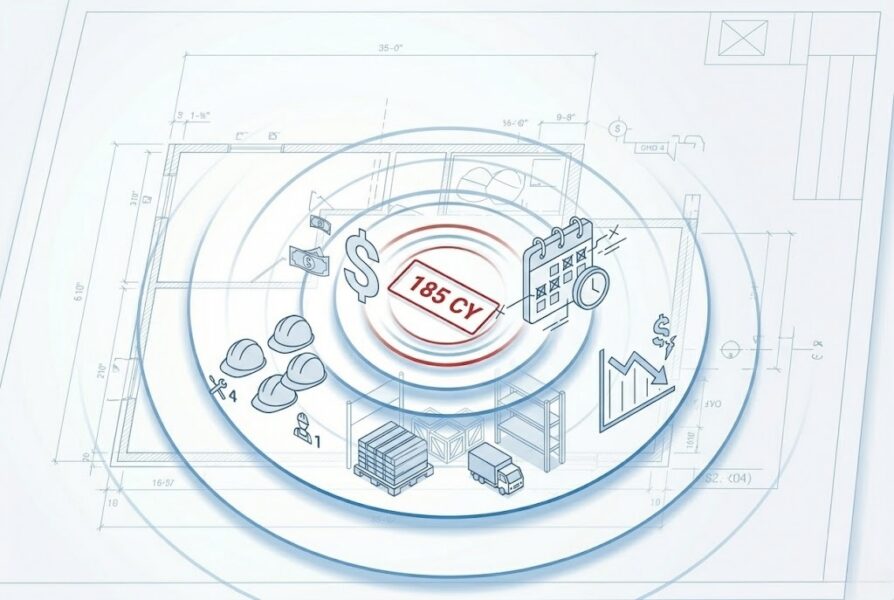
Most construction mistakes don’t happen in the field. They happen weeks earlier, at a desk, when someone measures 185 cubic yards of concrete and writes it down as fact. Then the crew shows up, the pour comes up short, and suddenly everyone’s scrambling to explain how the numbers were off by 10 yards.
That’s the thing about quantity takeoffs: when they’re right, nobody notices. When they’re wrong, the entire project feels it.
Small Errors Create Outsized Problems
A missed room. An unmeasured run of conduit. A slab thickness that was assumed instead of verified.
Individually, these sound minor. Walk into any project debrief where things went sideways, and you’ll hear the same refrain: “It was just one thing.” But that one thing multiplied across labor, materials and schedule becomes the reason a job that looked profitable on paper ended up underwater.
Because quantities drive almost every other decision. When the takeoff is off, everything downstream compounds:
- Pricing lands wrong — either too aggressive to be sustainable or too padded to win.
- Labor plans don’t match the real scope, and crews end up standing around waiting for clarity.
- Material orders fall short, deliveries get delayed, and the schedule slips while everyone points fingers.
- By the time the issue shows up in the field, it’s usually too late to fix it cheaply.
That’s the brutal economics of bad takeoffs: the error is cheap to prevent and expensive to repair.
The Winner’s Curse Starts with Bad Quantities
Underestimating scope is one of the most common ways takeoffs fail, not to mention one of the most dangerous.
When quantities are missed, bids come in low. You win the job. Congratulations. Except you didn’t win because you’re more efficient or better organized. You won because your estimate was incomplete. That’s winning work you can’t afford to build — the winner’s curse in action.
Now you’re locked into a contract where the only way to recover margin is through change orders, value engineering under pressure or eating the cost outright.
Overestimation isn’t harmless, either. Padding quantities to compensate for uncertainty might protect margin, but it makes bids less competitive. On a tight race, that extra 5% contingency buried in inflated scope can be the difference between winning and placing second.
Accurate takeoffs are what allow contractors to bid confidently without hiding behind excessive buffers. You price what’s there, not what might be there if everything goes wrong.
Accuracy Is Also About Trust, Accountability
Project managers rely on estimate quantities to build budgets and schedules. Superintendents use them to plan manpower and logistics. Procurement teams depend on them to stage deliveries and coordinate suppliers.
When those numbers don’t line up with reality, trust erodes quickly. And once trust is gone, every conversation becomes adversarial. The PM questions the estimate. The super questions the buyout. The owner questions the team. Everyone’s defensive because nobody knows which number to believe.
Modern digital workflows make every measurement visible on the drawing and traceable in the data. That transparency isn’t about micromanagement. It’s about making it easier to have productive conversations about scope before the job is awarded, when changes are still cheap.
When someone asks, “Where did this number come from?” you can show them. Not a vague explanation. The actual markup on the actual sheet with the actual measurement tied to it. That’s the kind of accountability that keeps teams aligned.
Accuracy Makes Estimates Easier to Revise
No set of drawings stays static. Addenda happen. Clarifications come in late. Architects change details three days before bid. Scope shifts.
When takeoffs are clean and well-organized, revisions are manageable. You can update affected quantities, isolate the differences, and assess downstream impacts without rebuilding everything from scratch.
But when takeoffs are messy — when assumptions are buried in formulas, or measurements aren’t tied back to drawings, or quantities are scattered across disconnected files — every revision becomes a partial rebuild. You’re not just updating numbers. You’re trying to figure out what the original numbers even meant.
Accuracy at the takeoff stage isn’t just about getting the first number right, but about creating a foundation that can absorb change without falling apart. Because change is guaranteed. The only question is whether your process can handle it.
The Uncomfortable Truth
No amount of pricing accuracy can fix bad quantities.
You can have the best cost database in the industry. You can negotiate killer subcontractor rates. You can sharpen your pencil until it’s a needle. None of that matters if the scope you’re pricing isn’t the scope you’re building.
The quantity takeoff is the independent variable. Everything else — pricing, labor planning, procurement, scheduling — depends on it. When it’s wrong, the estimate will be wrong, whether it’s over- or underpriced.
That’s why accuracy matters. Because the margin for error in construction is razor thin. On a good job, net profit might land in the low single digits. There’s no room for compounding errors that start early and ripple through the rest of the project.
So, before you rush to price, before you sharpen that pencil, make sure the quantities are right. Because if they’re not, nothing else you do will matter.