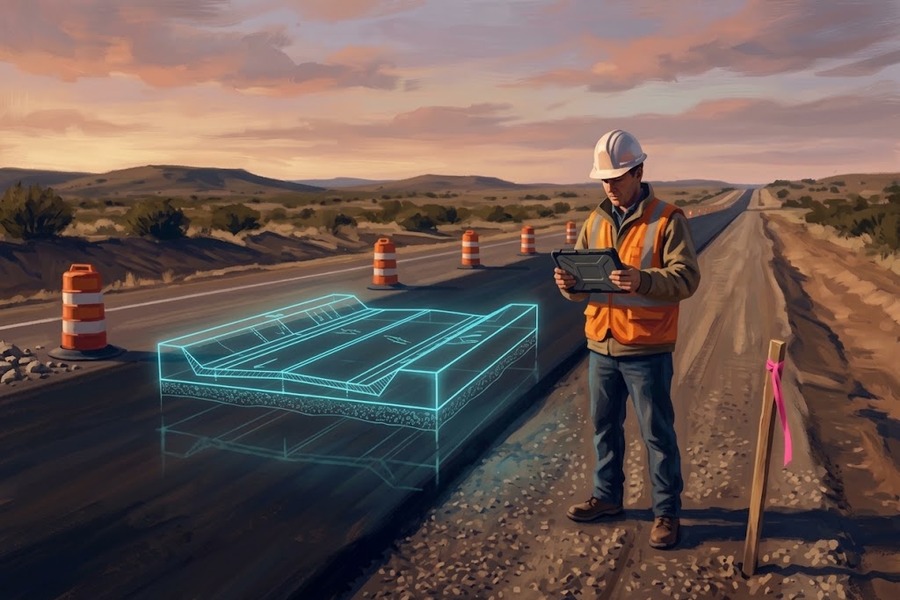
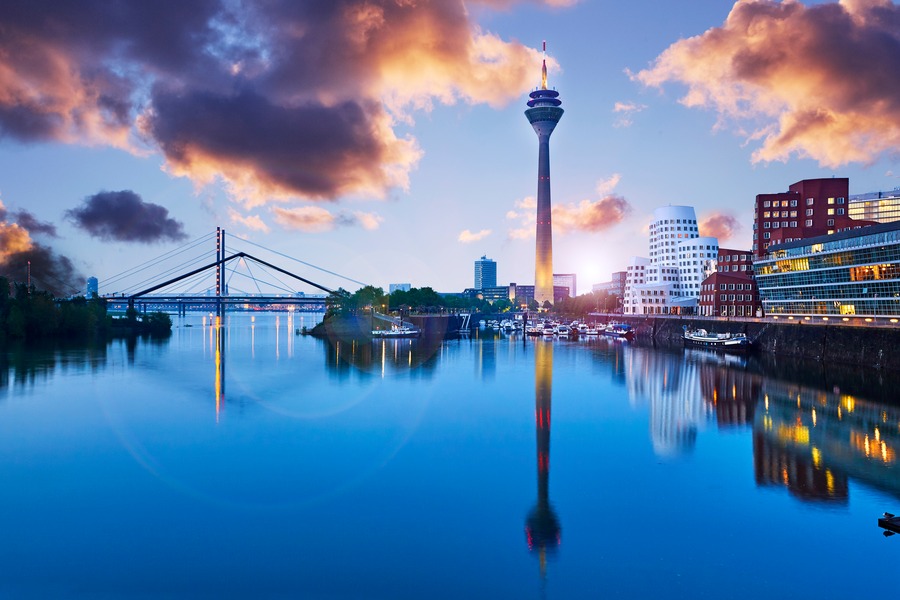
The Theodor-Heuss-Brücke has been carrying Düsseldorf across the Rhine since 1957. As of Feb. 1, 2026, it cannot legally carry a vehicle heavier than 3.5 metric tons — barely a loaded cargo van.
The city council voted in July 2025 to replace it. €37 million in emergency stabilization buys time; planning takes years; construction won’t finish this decade. Heavy freight reroutes around it — and the IHK Düsseldorf has noted, bluntly, that the alternative crossings are weight-restricted too. There aren’t a lot of options left for anything heavy.
This is what building in Düsseldorf looks like in 2026. Major surgery on a city that’s still wide open for business. Not impossible. Just expensive — and the costs aren’t landing evenly.
The City That Works, on Infrastructure That Doesn’t
Düsseldorf is the capital of North Rhine-Westphalia: around 620,000 people, a banking hub, one of the world’s most important trade fair cities. Messe Düsseldorf generates an estimated €2.98 billion in nationwide sales and 27,700 jobs in a normal year, per the ifo Institute. More than a million trade visitors come through annually.
On paper, the problem isn’t construction; it’s a backlog. Office construction sat at roughly 140,000 square meters in early 2026 — well below long-term averages. Vacancy is around 1.28 million square meters at 12.7%, up roughly a point year over year. Hybrid work hollowed out conventional demand. What’s leasing is leasing less, in better buildings, with better energy ratings. Everyone else is waiting.
Six Years to Build a Train to the Airport
The U81 Stadtbahn was supposed to link the rail network to the airport and Messe grounds in time for UEFA Euro 2024. Five matches were played at the Düsseldorf Arena that summer. Hundreds of thousands of visitors came through. The U81 wasn’t running.
Construction began in late 2019. Original budget: roughly €230 million. By December 2022 — pandemic, war in Ukraine, raw material spikes — it was €336.3 million, a 46% overrun. Then came the low voltage screwup.
In autumn 2024, the city found that the Niederspannungsanlage — the cable system for lighting, controls and displays — had been miscalculated. A second firm got pulled in. That single package became a chokepoint for up to 40 downstream work packages. By April 2025, the opening had slipped to Q2 2026. In January 2026, Rheinbahn CEO Annette Grabbe told the Rheinische Post it would open “by June 30 at the latest.” The technical board member who’d run the project, Michael Richarz, left the Rheinbahn effective May 19, 2025.
The engineering, for what it’s worth, is genuinely impressive. The Nordsternbrücke — a 441-meter, semi-integral steel truss bridge, incrementally launched over a live autobahn interchange across nine cycles — won the European Steel Bridge Award in 2024. The underground airport station, cut-and-cover beneath the arrivals level and designed to carry future buildings on top, is serious work.
What the U81 tells you isn’t that Düsseldorf can’t handle complexity. It’s that you budget for delay before you budget for concrete. The full system — eventually crossing the Rhine toward Neuss and Meerbusch (the crossing alone is pegged at €215–€275 million) and pushing east toward Ratingen — runs into the 2030s.
The Housing Math Nobody Has Fixed
Four is the number that explains Düsseldorf’s construction market — the consecutive years NRW building permits have declined. In 2024, NRW approved just 40,554 apartments, down 34% from 2021 and the lowest since 2012. Nationally, completions hit 251,900 — a 14% drop, the weakest output since 2010. The government’s target was 400,000. ZIA’s 2024 forecast put the shortfall at 600,000 units, on a trajectory to 830,000 by 2027.
Düsseldorf’s pressure is acute. BBSR’s housing-demand projections put new-build need for major cities at 45 apartments per 10,000 residents per year, with hot markets like Munich at 74. Düsseldorf sits in the higher-need cluster. The city’s 8,000-unit housing initiative through 2030, backed by a €140 million Impulsprogramm running through 2027, acknowledges the gap. It won’t close it.
New construction commands a steep premium. New-build asking rents run around €22 per square meter — about 45% above the city average. Oberkassel purchase prices sit around €6,600–€6,800 per square meter; Oberbilk closer to €3,900. And Düsseldorf condominium prices rose 8.9% year-over-year in Q2 2025 — fastest among Germany’s top seven, per Cushman & Wakefield. The people building those apartments mostly aren’t the people who can afford to live in them.
The Energy Retrofit Mandate Nobody Agreed On
Germany’s Gebäudeenergiegesetz — the Building Energy Act — is one of the most contested laws in recent German politics. The 2023 version mandating heat-pump installation triggered a backlash that gutted the governing coalition’s standing well before it finally collapsed over the federal budget fight in late 2024. What survived still pushes decarbonization, just slower. The CDU/CSU–SPD coalition’s February 2026 Eckpunktepapier proposes scrapping the core requirements — but as of late April 2026, the bill is stuck in cabinet dispute. The existing law stands.
On the ground, retrofit is real construction work. KfW covers up to 70% of heat-pump installation costs for private homeowners. Germany sold 299,000 heat pumps in 2025, up 55% year over year — the first year they were roughly half of all heating appliance sales, though BWP itself notes the rebound partly reflects dealers clearing 2023 inventory rather than pure demand growth. National installer backlogs eased through 2025; specialized HVAC capacity is still tight.
Düsseldorf’s Wärmeplan — the mandated heat-transition road map — is scheduled to go to council May 7, 2026 (provisional). Today, 92% of the city’s heat is fossil. The municipal target is climate neutrality by 2035. In the Altbau stock that defines the inner city, getting from here to there means external insulation that often won’t fly on heritage facades, internal insulation that eats floor area, and heat-pump retrofits that routinely double in scope once the walls open up. The contractors who do this well are booked.
Labor Is the Binding Constraint
Across housing, office renovation, infrastructure and energy retrofit, the constraint is the same. IW Köln projects a nationwide skilled worker shortfall of 768,000 by 2028 — up nearly 60% from 2024’s 487,000 gap. Around 62% of Tiefbau firms — civil engineering and underground construction — can’t fill the roles they have. That’s the highest rate of any subsector. In a market defined by exactly that work, the number matters.
New apprenticeship contracts in construction ran well below the retirement rate in 2024. Roughly 40% don’t finish. The average construction worker exits active employment at 58, and one in three pension recipients in the sector draws a disability pension. The physical reality of the job makes this structural, not cyclical.
Germany’s €500 billion infrastructure Sondervermögen is starting to flow, with NRW set to receive roughly €21.1 billion. That money is chasing the same constrained labor pool. More funding without more workers doesn’t build faster. IW Köln warned in early 2026 that the skills gap could brake the entire investment impulse.
Why Düsseldorf Is Worth Watching Anyway
The case for Düsseldorf isn’t that it’s solved any of this. The bridge is failing. The train is late. The housing gap is widening. The case is that Düsseldorf is doing something harder than building in a city with room to grow: replacing major pieces of a working city’s infrastructure in real time. That’s the job facing every western European city that built its bones in the postwar boom and is now watching them age out at once.
The U81’s Rhine crossing — planning starting now, construction around 2030 — will tie Heerdt and Lörick to the transit spine for the first time. Developers who positioned in those corridors made a smart call. The Theodor-Heuss-Brücke replacement builds in a structural provision for later rail integration even though the current plan doesn’t fund it. Optionality on something the city will use for 60 years.
Policy is moving too. Germany’s “Bau-Turbo” fast-track permitting, in force since October 30, 2025, cuts review timelines for densification and adaptive reuse. Modular construction is still about 5% of the residential market by unit count, but mainstream bank financing is normalizing. Unmet demand is the mother of method change.
Düsseldorf’s construction market in 2026 is under real pressure — from a city that’s genuinely growing, genuinely in demand and genuinely constrained. The math works fine for everyone who already owns something. The question is whether it can build fast enough for everyone else.