Winning a pitch competition is one thing. Knowing what to do with it is another.
When Qflow walked off the stage at Bluebeam’s Unbound Conference in October 2025 in Washington, D.C., the materials and waste data startup had a trophy, momentum and, more importantly, a seat at the table. The Startup Spotlight win unlocked a series of working sessions with leaders from Bluebeam and Nemetschek Group — not more pitching, but the harder, more useful work of pressure testing a business in real growth mode.
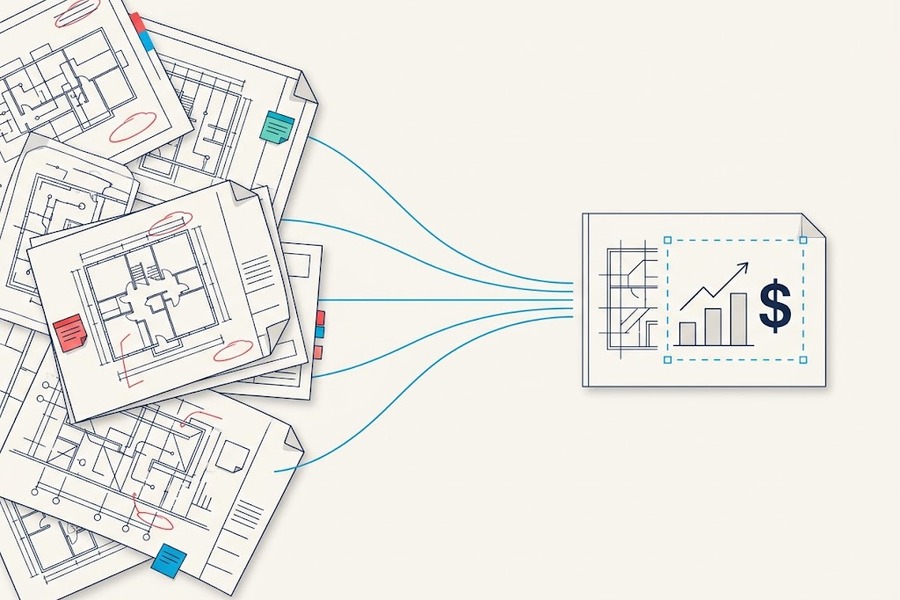
Qflow captures and structures data around materials and waste on construction sites — turning delivery notes and waste records into clean, usable information that project teams can ultimately act on. With sophisticated auditing Qflow flags risks to the project teams, helping them to avoid risks such as re-work, better manage their supply chain and accurately account for their impact. It is a problem every project team feels. Few have solved it.
For co-founder and CEO Brittany Harris, the sessions came at exactly the right moment. The product was working. Customers were enthusiastic. But the company was bumping up against the question that trips up most startups at this stage.
Built spoke with Harris about Qflow’s journey, what she took away from the experience and what it really means to scale in construction tech.
Built Blog: For anyone who hasn’t heard of Qflow, what are you building and what problem does it solve?
Harris: At its core, we are bringing clarity to one of the messiest and opaque parts of construction — materials and waste. It accounts for over 40% of a project’s budget and 90% of its embodied carbon, but still, its management is ad hoc and largely paper based. Every project has enormous amounts of information moving through the supply chain, but almost none of it gets captured in a way that is structured or actionable.
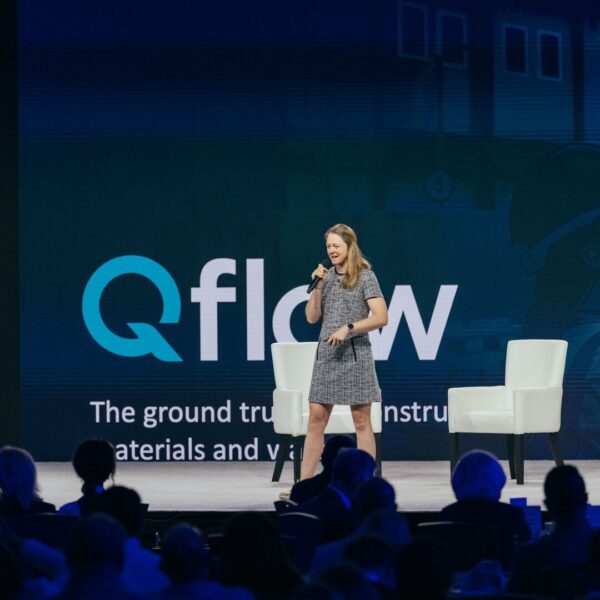
We use AI and human verification to turn things like delivery notes and waste records into clean, usable data, and then we audit the hell out of it. Project teams can finally see what is happening on site — what is being delivered, what is being wasted and where the risks are.
What we’ve learned is that this isn’t just a sustainability problem, even though that’s where we started. It is also about quality, cost and accountability. If you do not know what is really being built, you cannot manage any of it effectively.
Built Blog: What did winning the Startup Spotlight mean for you and the team?
Harris: It was a big moment — not just for the visibility, but for what came after. Winning meant real time with leaders across Bluebeam and Nemetschek. That is very different from pitching on stage. You are not telling your story anymore. You are having your assumptions challenged by global industry leaders in our space.
For a team at our stage, going from startup to scale up, that kind of access is genuinely valuable.
Built Blog: What were you trying to figure out going into those sessions?
Harris: We are at that classic inflection point — from UK founder-led startup to global scaling company. The challenges are completely different.
Three things were top of mind: how we think about pricing and packaging as we grow, how we improve product marketing and drive adoption, and how we build a customer success function that scales with the business. We’ve built something customers really value. The next challenge is making that repeatable.
Built Blog: What surprised you most about the conversations?
Harris: How practical they were. It wasn’t theoretical advice — it was grounded in real experience. People shared what had worked, what hadn’t and where they had made mistakes at similar stages.
I was also impressed by the humility of the team — every company has a different journey, and we have different target customers, so what works in one place may not work in another. They focused on discussing core principles and experiences over hard solutions, giving us the space to figure out what will work for Qflow and our clients.
Built Blog: Did anything challenge your assumptions?
Harris: We’ve not really done any focused product marketing to date and have let the product and our clients speak for themselves, which is fine at the early stages, but as Qflow evolves to include more capabilities and service more user types, we need to get more strategic about how we talk about the product.
The conversation with the Bluebeam team was useful to provide a different perspective; while you can carry out agile development and do lots of small feature releases to gather lots of customer feedback, the marketing of key features can be held back and grouped to form overarching narratives that engage key user groups specifically. We are still figuring this out for Qflow, but it is a great start on the journey.
Built Blog: You came to market through a sustainability lens. Has that changed?
Harris: Sustainability is still core to what we do and how we operate, but it is no longer the only focus. We have found that the same data solves multiple problems. A sustainability team cares about carbon reporting. A quality team cares about whether the right materials were used and what that means for re-work and the quality of the end asset. A commercial team cares about cost and risk; are they paying for what they have and how vulnerable their supply chain is.
So, we have broadened Qflow’s capabilities to reflect that. It is still one platform; now it delivers value to multiple stakeholders across a project. That has been an important shift as we think about how we deliver sustainable, scalable impact across this amazing industry.
Built Blog: What would you tell other startups at a similar stage?
Harris: Don’t underestimate how different the next phase is. What gets you to your first few million in revenue is not what gets you to the next level. You have to rethink how you operate; how you price, how you communicate, how you support customers.
Also, stay open to outside perspective. Access to people who have been through it before can cut years off your learning curve. We have learned [from] all kinds of mentors and advisors at each stage, and although we may not implement everything they say, we have learned a huge amount in the process that has made us a more robust company.
Built Blog: What’s next for Qflow?
Harris: Scaling what we have already proven. That means expanding our enterprise footprint, continuing to evolve the product to deepen our value to cost and quality teams across every customer we work with. Only by linking sustainability to these core functions can we ensure that we continue to progress along this important journey in the face of economic and political turmoil.
We have already established a team and beachhead clients in North America and are really excited by the traction and rate of growth across the Atlantic. We are also looking at new markets, particularly in Europe, which brings its own challenges and opportunities. But fundamentally, the focus hasn’t changed: helping construction teams make better decisions with better data to build a more sustainable future.