
Everyone in construction — and everywhere else, really — is talking about AI.
Copilots. Agents. Automated takeoffs. The demos are slick, and the headlines keep getting louder. What’s more, the promises are seductive: fewer people, faster bids, more precise procurement, smarter workflows.
Yet there’s a question almost no one is asking:
Can AI really read a drawing?
Most of today’s AI is built for language: It summarizes specs; drafts emails; answers questions about contracts. All useful … until you realize that some of the most expensive mistakes in construction don’t live in paragraphs, but in geometry.
A door listed in a schedule but missing from the floor plan, a subtle revision between drawing sets that shifts cost exposure, a mismatch between visual conventions and written labels — these are spatial problems, not language or grammar ones.
If AI cannot see what is happening on a page — not just read the words attached to it — then a significant share of construction risk stays invisible.
The next real shift in construction AI may not be conversational at all. It may be visual, spatial, domain-specific. Less about generating content and more about catching what humans are most likely to miss, while keeping humans firmly in charge of the final call.
Why Construction Risk Lives in Geometry, Not Text
If you want to know whether AI is useful in construction, stop asking what it can write and start asking what it can catch.
The industry’s biggest headaches rarely trace back to a poorly phrased sentence in a specification. They come from coordination gaps that hide in plain sight — buried in drawing sets that run hundreds, sometimes thousands, of pages. And as Bluebeam’s own work with AI-driven drawing review has shown, the costliest mistakes are often the ones nobody caught until crews were already on site:
• A door shows up in the schedule but never makes it onto the floor plan.
• A symbol appears in elevation but not in section.
• A revision shifts a wall a few inches and changes quantities downstream.
• A glass type is labeled one thing, drawn another.
Individually, these seem minor. Collectively, they become change orders, delays, rework, blown budgets and strained relationships. According to a SpecFinder analysis of industrywide data, rework consumes roughly 5% to 9% of total project value, and change orders account for 8% to 14% of total contract value, with distressed projects running as high as 25%.
These aren’t language failures. They’re geometry failures.
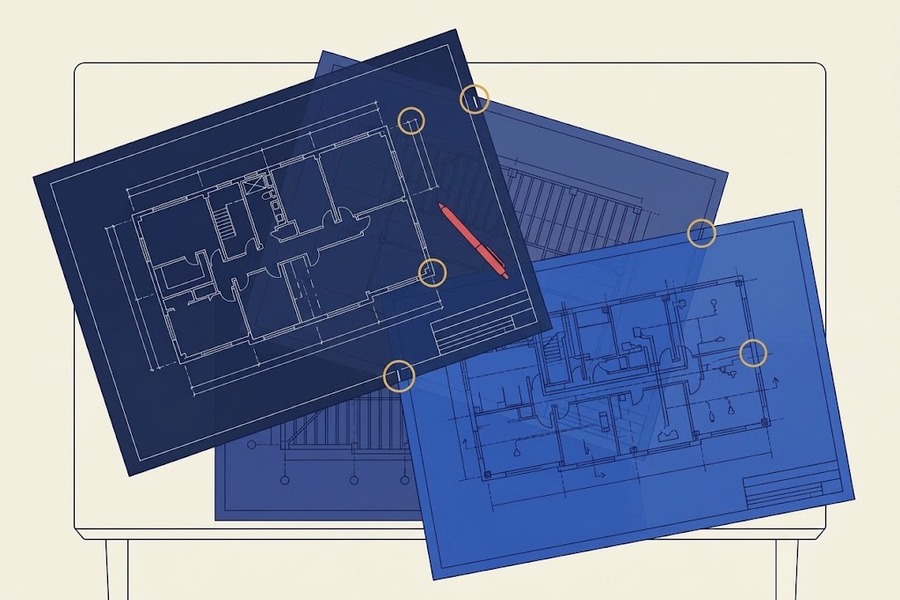
What’s more, they’re about spatial relationships, like how elements connect, overlap, align and sometimes contradict each other across views; about consistency between plan, elevation and detail; and, perhaps more crucially, about the delta between Rev. 3 and Rev. 4 that someone must manually scan before a bid is due.
For decades, the industry has relied on experienced professionals to spot these issues through repetition and instinct: highlighters, markups, side-by-side comparisons. In other words, careful, skilled work — but human work, nonetheless. However, humans get tired, and that dependence on institutional knowledge is growing more precarious: NCCER projects that roughly 41% of the construction workforce will retire by 2031, taking decades of earned pattern recognition with them.
That’s the blind spot for most text-first AI. It can read the spec and tell you what “Door Type A” means, but can it confirm that every instance of that door exists where it should? Can it recognize that a hatch pattern implies spandrel glass even if the label says “clear”? Can it compare two drawing sets and isolate only what changed visually?
Until AI can operate at that spatial layer — not just the textual one — it risks solving the easy part of the problem while leaving the expensive part untouched.
Document Intelligence vs. Drawing Intelligence: A Critical Distinction
Text-first AI isn’t useless in construction.
It helps summarize specifications, extract submittal requirements, answer compliance questions and surface clauses in long contracts. These are real efficiency gains. Yet, it’s still operating at the document layer, and construction projects operate at the drawing layer.
As Bluebeam’s own guide to reading and interpreting engineering drawings makes clear, a drawing isn’t a static image so much as a dense system of symbols, line weights, hatching patterns, dimensions and relationships. A wall isn’t just a line; it’s tied to doors, windows, hardware schedules, fire ratings and structural constraints. Change one element and you may affect five others.
That’s where a different kind of AI starts to matter.
Call it spatial intelligence. Call it drawing intelligence. The label matters less than the shift it represents.
Instead of asking, “What does this spec say?” the questions become:
• What changed between these two revisions visually?
• Does every door listed in this schedule exist in the plan?
• Are these callouts connected to valid details?
• Does this symbol appear consistently across views?
These aren’t natural language queries; they’re geometric validations.
Technically, that means moving beyond pure language models and into computer vision and structured relationship mapping — systems trained to recognize shapes, patterns and spatial conventions specific to construction documents. Research from AWS and TwinKnowledge demonstrates how combining large language models with computer vision can process thousands of architectural drawings while maintaining near-human accuracy on QA/QC, precisely the kind of scale that manual review cannot match.
In practice, the AI isn’t trying to replace the professional but acts more like a second set of eyes, scanning for inconsistencies at scale, highlighting potential risk and narrowing the field of what needs human attention.
Document intelligence makes information easier to consume; drawing intelligence, meanwhile, makes coordination risk harder to miss.
If AI is going to earn trust in construction, it probably won’t be because it chats fluently but because it catches what would otherwise become a change order.
Human-in-the-Loop AI: Why Full Autonomy Doesn’t Fit Construction
Construction companies don’t roll out new technology the way a startup deploys an app update.
In plenty of industries, a software mistake means a broken dashboard or a delayed report. In construction, it can mean a failed inspection, a safety incident or a six-figure change order. PlanRadar’s 2025 Construction QA/QC Impact Report found that firms without consistent QA/QC standards are 21% more likely to experience avoidable rework and 50% more likely to face warranty exposure.
That’s why fully autonomous AI — the “let the agent handle it” model — feels out of sync with how this industry operates.
Construction is built on accountability. Licensed professionals stamp drawings. Contracts define scope. Insurance policies hinge on who signed off on what. None of that can be outsourced to a black box.
The more realistic path is augmentation, not replacement.
The most promising systems don’t try to redesign the building. Instead, they narrow the review field; flag inconsistencies; highlight deltas; surface potential conflicts. Then step aside.
Human-in-the-loop isn’t a compromise. It’s the only model that makes sense in a liability-sensitive environment.
Construction teams need accuracy and explainability. They need to understand why something was flagged and how that conclusion was reached. MIT Technology Review’s reporting on AI and construction safety makes the limitation concrete: visual language models still struggle with spatial reasoning, and even very high accuracy rates may not be sufficient when the remaining errors involve missed clashes. A hallucinated paragraph in a chatbot is annoying; a hallucinated clash detection could be catastrophic.
The question, therefore, isn’t whether AI can outsmart a seasoned estimator or project manager.
It’s whether AI can reliably act as a force multiplier — scanning thousands of pages faster than any human could while leaving final judgment exactly where it belongs.
The 2D vs. 3D Reality: Where AI Can Close the Gap
The industry has long talked about BIM and digital twins as if they would eliminate ambiguity altogether.
In theory, the 3D model is the source of truth: It contains intelligence, quantities and relationships.
In practice, however, most projects still hinge on 2D documents.
As Bluebeam’s guide to engineering drawings notes, permits are reviewed in 2D; contracts reference 2D sheets; subcontractors build from 2D drawings in the field. Even in countries where BIM Level 2 is achieved, local legal regimes often require 2D drawings to be on hand, as the PDF remains the legal and practical record of the project. According to survey data in Bluebeam’s AEC Technology Outlook 2025, more than 70% of respondents still work primarily from blueprints in their original 2D form.
That creates tension.
The model may change. The drawing may lag. A schedule may update in one place but not another, and a detail may look correct in 3D but miscommunicate in 2D output.
This gap between the live model and the contractual snapshot is where coordination risk accumulates. Spatially aware AI has a meaningful role here — but it’s not as a replacement for BIM, but as a validation layer between worlds.
If AI can compare model-derived schedules to 2D plans, flag inconsistencies and detect visual mismatches before they hit the field, it becomes less of a novelty and more of a safeguard.
The industry doesn’t need another dashboard. What it needs, desperately, are fewer surprises between what was designed, what was documented and what gets built.
What Construction AI Must Prove in the Physical Economy
Construction isn’t the only industry wrestling with this. Manufacturing, energy and infrastructure also operate in the physical world. They deal in materials, tolerances and real-world consequences.
The question is whether the dominant, language-first wave of AI is enough.
If a model can write a clean memo but can’t detect a clash between systems, what problem is it solving? If it can summarize a contract but can’t flag that a critical element disappeared between revisions, how much risk is it really reducing?
The physical economy forces a harder standard.
It’s not enough for AI to be articulate. It has to be observant. ENR’s recent reporting on visual intelligence in construction frames the shift precisely: the next phase isn’t about AI that can chat about your project but about AI that can see it, understand spatial relationships and flag where reality is drifting from plan.
Construction is ultimately an unforgiving test case.
Projects are expensive. Timelines are tight. Margins are thin. Liability is real. That environment doesn’t reward flashy demos so much as tools that reduce rework, accelerate reviews and surface issues before they cascade. Industry experts are consistent on this point: the AI tools that will earn adoption aren’t the most impressive but the most useful — on the ground, on deadline.
If AI can prove itself there — not necessarily as a replacement for expertise, but as a reliable layer of spatial validation — it may earn its place across other capital-intensive industries.
If it can’t, much of the physical economy will remain resistant to automation that only understands words.
The Future of Drawing Intelligence: Predictive Risk and Real-Time Validation
If drawing intelligence becomes reliable — not perfect, but reliable — the implications go beyond faster review cycles. The first step is surfacing inconsistencies, highlighting deltas and flagging missing elements. The next layer then becomes possible.
Predictive risk scoring. Instead of simply pointing out what changed, AI could identify which changes historically correlate with change orders, RFIs or coordination delays. Not just “what changed,” but “what changed that matters.”
A 2026 roundup of AI-driven AEC solutions from BuiltWorlds profiles a growing class of tools built for exactly this: drawing analysis, code compliance auditing and automated RFI generation from drawing conflicts.
Automated compliance checks. Many building codes depend on spatial logic like clearances, egress distances and door swings. If AI can interpret geometry consistently, it can begin validating certain compliance conditions before plans leave the office.
Real-time model validation. As models evolve, AI could act as a constant validation layer between the live 3D environment and the 2D outputs contractors and regulators rely on. If a schedule updates but the drawing doesn’t reflect it, that discrepancy gets flagged immediately.
In that future, AI becomes less of a flashy overlay and more of an embedded safety net.
• It watches relationships between elements.
• It notices when something drifts out of alignment.
• It raises its hand before the field does.
This is already the direction Bluebeam is moving. The acquisition of my company, Firmus — an AI purpose-built to surface drawing errors before they turn into field rework — and tools like Auto Align and Automatic Title Block Recognition are early expressions of drawing-layer intelligence: not AI that generates content, but AI that validates it.
That’s also the foundation of Bluebeam Max, an AI layer built directly into Bluebeam that brings drawing intelligence to the workflows construction teams already rely on. Rather than asking teams to adopt an entirely new platform, Max adds spatial validation, insight and automation where the work already happens.
The real breakthrough may not be AI that can generate a building. It may be AI that helps ensure the one you’re already designing is internally consistent before it ever reaches the jobsite.