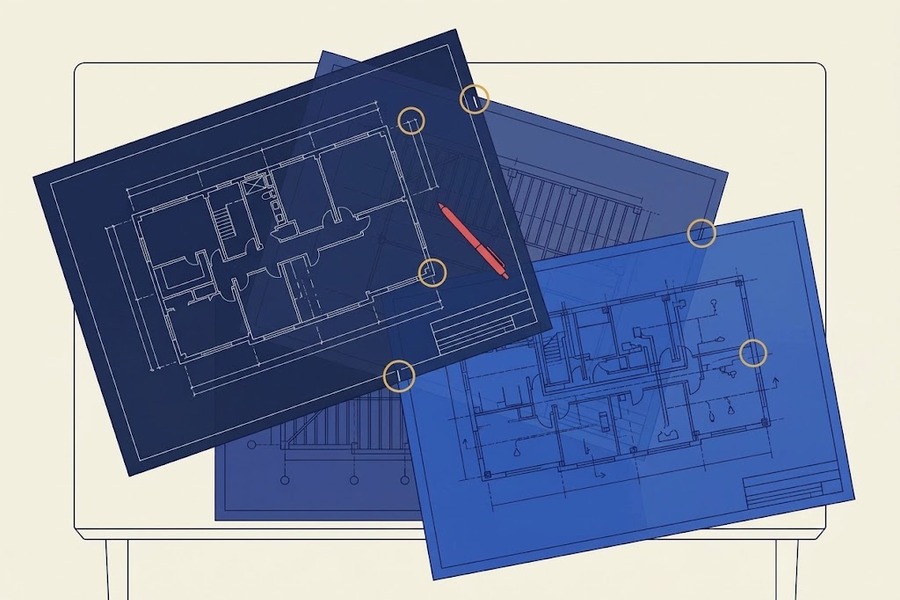
A journeyman used to show up, grab paper prints off the table and go to work. That day is ending. Walk onto a data center job today and the foreman hands you a laptop, not a roll of drawings, and expects you to already know your way around software like Bluebeam. At the Electrical Training Alliance of Silicon Valley (ETASV), the union electricians building the Bay Area’s data centers learn it before they ever hit the site.
Why is a union electrician learning software at all?
The old line between “field” and “office” is collapsing. As data center work floods Silicon Valley, the electricians who move up aren’t just the ones who can bend pipe. They’re the ones who can read, mark up and manage a drawing set on a screen without missing a beat.
“Gone are the days of just showing up and working with your hands,” said Chris Paup, a journeyman electrician, ETASV instructor and business representative for IBEW Local 332. “Technology has implemented itself in this industry in so many different ways that you really have to take control of your own education.”
Paup would know. He built ETASV’s Bluebeam Fundamentals course from the ground up. And the reason the school leaned in isn’t a hunch about the future. It’s the work already landing on its doorstep.
How much of a data center is actually electrical work?
This is the number that reframes the whole trade. Data centers aren’t buildings with some wiring in them. They are, functionally, electrical machines the size of warehouses, and the crews who energize them carry the bulk of the job on their backs.
The IBEW estimates 45% to 70% of a typical data center’s construction cost goes to the electrical subcontractor. That’s not a rounding error, either; that’s the job. What’s more, the demand behind it isn’t slowing: the U.S. is looking at roughly 81,000 electrician openings a year over the next decade, even as older workers retire faster than new ones sign up.
ETASV Training Director Albert Lancaster doesn’t talk about AI in terms of chatbots. He talks about it in terms of copper and steel. “When I think of AI, I don’t typically think of the user interface,” he said. “What I think of is the backbone behind it, and the infrastructure needed to power the AI. That’s where our training center comes into play.”
How do you teach Bluebeam to someone who’s never touched it?
The hard part isn’t the software. It’s meeting a field worker where they are, then showing them the tool does far more than mark up a PDF. ETASV splits that job across two instructors and two courses, so nobody gets thrown in the deep end.
Paup’s Fundamentals course assumes zero knowledge. Step one is literally what the icon looks like and how to pin it to your taskbar. From there, students learn to navigate the interface, draw, assign data to their markups and build the custom columns that turn Bluebeam from a viewer into a calculator.
Then they walk into Chris Doyle’s advanced class. Doyle, a longtime journeyman and a detail manager who works an active data center project in Reno, Nevada, hands students a profile packed with a giant tool set and roughly 100 custom columns he’s built over years, then teaches them to design real projects with it. Paup builds the engine. Doyle teaches you to drive.
Doyle pulls real problems straight off the job and into the classroom. One first-day exercise hands students an actual EV charger plan with a genuine code error buried in it, a ground that wasn’t upsized, and tells them to find it. “Feel free to cheat and share as much as you want,” he tells them, “because that’s what you’re going to do in the field.”
What does a Bluebeam class earn a working electrician?
Training only sticks when it counts toward something real. At ETASV, the payoff is built into the trade’s own rules: the course doesn’t just make you sharper, it keeps your license current.
The Fundamentals course runs 54 hours of classroom instruction and application, well beyond the continuing education a journeyman needs to renew their California license every three years. “The purpose of continuing education is so you don’t get stale,” Paup said. “This helps them stay on the forefront.”
There’s a bigger prize on the horizon, too. When a contractor calls the union hall, they can ask for workers certified in confined space or high voltage. For Bluebeam, the best they’ve been able to ask for is “experience preferred,” because there was never a way to prove the skill. ETASV wants to change that: build out the full course series, add a real exam and issue a certificate a contractor can actually request by name.
Is construction software really built for the trades, or just the office?
This is the chip on the shoulder of every field worker who’s been told a tool wasn’t made for them. The people teaching it at ETASV reject the premise outright, and they’ve got the workflows to prove it.
“The concept of ‘I’ll never touch a computer as a journeyman in the field’ is going to be over pretty soon,” Paup said. “In the next five to six years, instead of getting handed a printout, paper’s going to be obsolete. You’re going to get an iPad on the job. You need to know how to navigate these things to stay relevant, to stay future-proofed in your own career.”
Doyle puts the stakes in numbers a contractor feels. “If there’s any mistakes in a UPS system, you’re talking about millions of dollars in downtime,” he said. “The bar is very, very high, not just because we as an institution want it to be, but because that’s what the industry demands.”
The bottom line for the trades
ETASV is the largest electrical apprenticeship in Northern California, and it’s not chasing the technology wave, it’s teaching ahead of it. The workers coming out of that building in Milpitas are the ones who’ll wire the infrastructure the AI era runs on. And thanks to two instructors, one who built a course on a military deployment and one who’s seen every boom and bust the trade’s had, they’ll walk onto the job already knowing the tools.
“We have this opportunity to really mold people for jobs that don’t exist yet,” Doyle said. “And we’re figuring that out as we go.”
Read the full story of how ETASV built Bluebeam into its curriculum in the complete customer case study on bluebeam.com.
Frequently asked questions
Do electricians use Bluebeam?
Yes. Electricians and MEP trades use Bluebeam for quantity takeoffs, material planning, drawing markup and field-to-office coordination. At ETASV, union apprentices and journeymen learn it as part of their formal curriculum.
What share of a data center is electrical work?
The IBEW estimates 45% to 70% of a typical data center’s construction cost goes to the electrical subcontractor, making electricians the core trade on these projects.
Does a Bluebeam course count toward electrician continuing education?
At ETASV, the 54-hour Bluebeam Fundamentals course counts toward the continuing education hours a journeyman needs to renew a California electrician license, which is renewed every three years.
What is ETASV?
The Electrical Training Alliance of Silicon Valley is an electrical apprenticeship in Milpitas, California, jointly funded by IBEW Local 332 and the NECA Santa Clara Valley chapter. It is the largest electrical apprenticeship in Northern California.