Dan Carlson was inspecting the new east grandstand at Oregon State University when he stepped into the contractor’s job trailer to check the plans. On a 60-inch monitor, the drawings were up and live in Bluebeam. His first thought: “Wow, what is that?” His second: “That looks super cool.” That moment in a job trailer now shapes how Chemeketa Community College trains the people who will sign off on Oregon’s buildings for the next generation.
Why is Oregon running short of building inspectors?
Every permit, every final inspection and every rebuild after a disaster runs through a code professional. When that workforce thins out, projects stall at the counter and communities wait. Oregon’s gap is a pipeline problem: retirements are outrunning the handful of programs built to train people for the seat.
The math is blunt. Three programs train code professionals in Oregon — the state Building Codes Division, Chemeketa and Portland Community College — and together they turn out fewer than 50 a year, according to figures Carlson tracks across all three. The Oregon Employment Department projects about 200 openings a year for construction and building inspectors. And the cliff has been visible for a decade: a 2014 survey that the National Institute of Building Sciences conducted for the International Code Council found that 82% of code professionals planned to retire within 15 years, including 31% within five.
It isn’t for lack of a good job. Construction and building inspectors in Oregon earn an average of $85,154 a year, according to Oregon Employment Department wage data. Chemeketa’s Building Inspection Technology program, in Salem, has offered a building inspection degree since 1978 and has produced more than 800 graduates, according to the college. Its cohort is capped at 30 students a year. Last year, 52 people applied.
How did Bluebeam end up in a building inspection classroom?
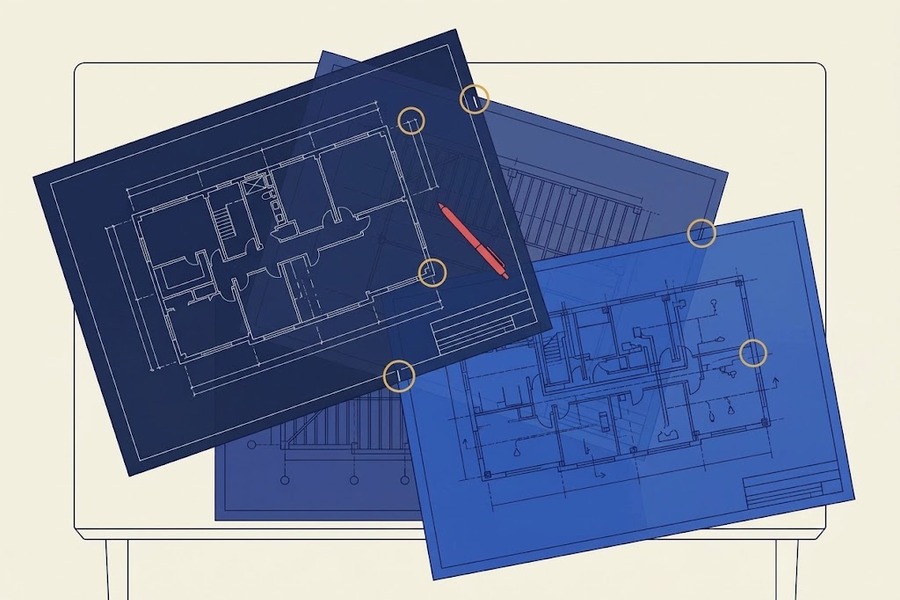
Code enforcement used to run on a red pen and a roll of drawings. Building departments don’t work that way anymore, and a program that pretends otherwise sends graduates out a step behind. Chemeketa made a deliberate call to teach the tool the job runs on today, not the one it used to.
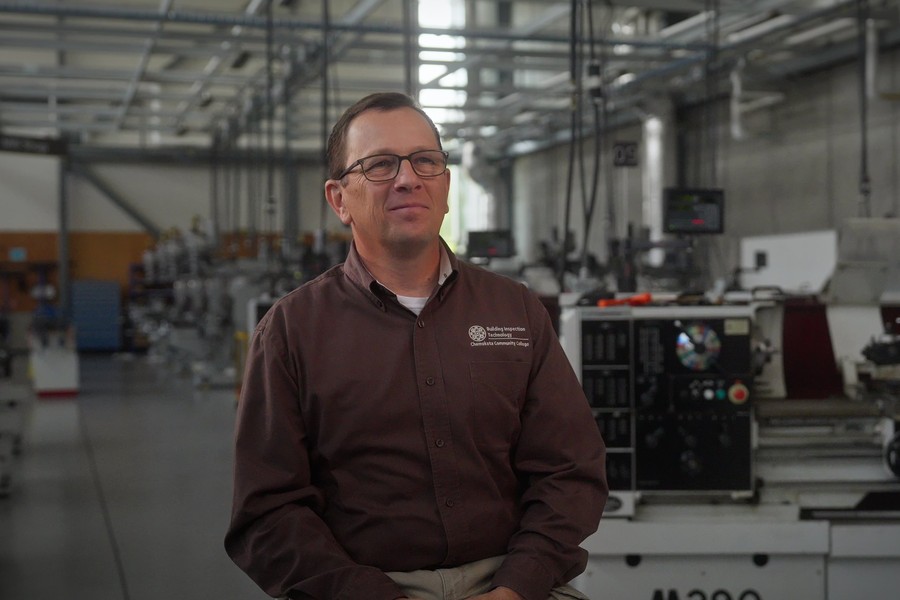
Carlson knows the program from both sides of the desk. He graduated from it in 1996, spent 14 years as the building official in Corvallis and now serves as building official for the city of Wilsonville. When Chemeketa restarted the program in 2016, he came back to teach. Then the COVID-19 pandemic hit, and passing paper plan sets around a classroom stopped making sense.
“We had to get real about doing electronic plan review in the classroom,” Carlson said. “And Bluebeam was the answer.”
The state was heading the same direction. House Bill 2415, passed in 2021, directed the state to set minimum standards for electronic plan review, permitting and inspections, and required local building departments to meet them starting Jan. 1, 2025. Chemeketa runs on licenses provided through the Bluebeam Academic Program, and Carlson became a Bluebeam Certified Instructor to teach it.
Students take a one-credit Essentials of Bluebeam class in their first term. After that, the software never leaves: every plan review, assignment and group project over the two-year program runs through it, including Studio Sessions where classmates mark up the same set together. Nearly all classes meet live over Zoom three or four evenings a week, which is how the program pulls students from Oregon, Washington, Idaho, Montana, California and, once, Minnesota. The degree costs roughly $20,000, according to the college, with eight ICC certifications built in.
What does electronic plan review change for a building department?
Plan review is where a project’s schedule lives or dies. When every reviewer has to wait for the paper set to come around, the permit counter becomes the bottleneck. Putting all the disciplines on the same drawings at the same time changes who controls the clock.
Carlson estimates electronic plan review runs 30% to 60% more efficiently than paper. He has a favorite proof. In 2019, Wilsonville hosted the NW Natural Street of Dreams, a showcase of six new homes, and the city ran plan review differently.
“Builders have a schedule. They know when they’ll submit plans to the city and how long it should take,” Carlson said. So builders scheduled their submissions in advance, and the city blocked those dates on reviewers’ calendars. On review day, reviewers from several disciplines marked up the same plan sets at once in Bluebeam Studio. All six homes cleared review in a single day. Applicants either had a permit in hand the next day or knew exactly what to fix. The city’s community development staff called it a paperless beta test of the future of plan review, according to a July 2019 city report.
“It’s the type of streamlined permit process I wish we could do with every project,” Carlson said.
Can a career in the trades lead to building inspection?
Some of the sharpest inspectors don’t come from offices. They come off roofs and out of crawl spaces, carrying years of knowing how buildings go together. For a tradesperson whose body can’t keep up with the work, inspection isn’t a step away from construction. It’s a way to stay in it.
Heidi Kameroff spent about 20 years in the trades as a journeyman roofer before an injury took her off the roof for good. “I didn’t want to leave an industry that I had worked so hard to become a journeyman in,” she said. “But physically, there was no way for me to continue to do what I did. And you can’t really be a remote roofer.”
Vocational rehabilitation wanted to steer her into office jobs. She found Chemeketa online instead, and by the end of the program she “was suddenly passionate about something again.” Today she is a building inspector and plans examiner for Lincoln County on the Oregon coast, where she inspects homes being rebuilt after the 2020 wildfire that tore through the Otis area. “Nobody ever thought that the coast would catch on fire,” she said.
“Bluebeam didn’t become essential in my life until I became a code professional,” Kameroff said. “Now I open it every single day.”
Heaven Doherty took a different road in. She spent years with a general contractor and in local government finance before moving into a building department, and she completed Chemeketa’s program while working full time for the city of Pendleton, the Hermiston Herald reported. Now she inspects and reviews plans for the city of Hermiston in eastern Oregon, and the Oregon Building Officials Association named her its 2026 Building Inspector of the Year. “It’s always a privilege to serve your community and to make things safer and better for people,” she said. She credits Chemeketa for the technical depth behind that work — without the program, she said, “I couldn’t do my job at the level I do it.”
Why do building departments hire Chemeketa graduates?
A new hire who needs a year of handholding is a cost a short-staffed department can’t absorb. What employers are really buying from a program like this is time: inspectors who can carry a caseload from the first week instead of learning the code book and software on the clock.
About half of Chemeketa’s building inspection students are hired before they graduate. John Rodriguez, Lincoln County’s building official, hired Kameroff and saw the difference right away. “I didn’t have to do a whole lot of extensive training for plan reviews with my hire — she was very capable from the start,” he said. “You know you’re hiring a capable and well-versed person for your staff in codes and plan review.”
Carlson hears the same thing from the other side of the hiring table. “They’re getting someone who’s been exceptionally well prepared to leap right into the deep end,” he said. “They’re not having to learn Bluebeam on the job.”
The bottom line for the trades
Oregon isn’t waiting on the shortage to fix itself. Senate Bill 1086, passed in 2025, directs the Oregon Department of Consumer and Business Services to help the Oregon Building Officials Association develop a proposal for a building inspector apprenticeship program. The association has identified Chemeketa as its intended education provider and is targeting a 2027 launch. A night-and-online model that turns tradespeople and career changers into job-ready code professionals isn’t a uniquely Oregon answer either. Every state staring down the same retirement wave could use one.
For the people coming out of it, the job is bigger than a checklist. “We’re advocates, not just inspectors,” Kameroff said. “We’re advocates for safer buildings, safer structures.”
Read the full story of how Chemeketa built Bluebeam into its building inspection program in the complete customer case study on bluebeam.com.
Frequently asked questions
Do building inspectors use Bluebeam?
Yes. Building departments use Bluebeam for electronic plan review, drawing markup and real-time collaboration in Bluebeam Studio Sessions, where reviewers from multiple disciplines can mark up the same plan set at once. At Chemeketa Community College, building inspection students learn it in their first term.
How many building inspectors does Oregon need?
The Oregon Employment Department projects about 200 openings a year for construction and building inspectors. Oregon’s three training providers — the state Building Codes Division, Chemeketa Community College and Portland Community College — together turn out fewer than 50 new code professionals a year, according to figures compiled by Chemeketa instructor Dan Carlson.
Is electronic plan review required in Oregon?
Yes. Under House Bill 2415, passed in 2021, local building departments in Oregon must meet state minimum standards for electronic plan review, permitting and inspections, starting Jan. 1, 2025.
What is Chemeketa’s building inspection program?
Chemeketa Community College in Salem, Oregon, has offered a building inspection degree since 1978. Its Building Inspection Technology program is a two-year degree that costs roughly $20,000, according to the college, builds in eight International Code Council certifications, holds nearly all classes live online in the evenings and caps enrollment at 30 students a year.