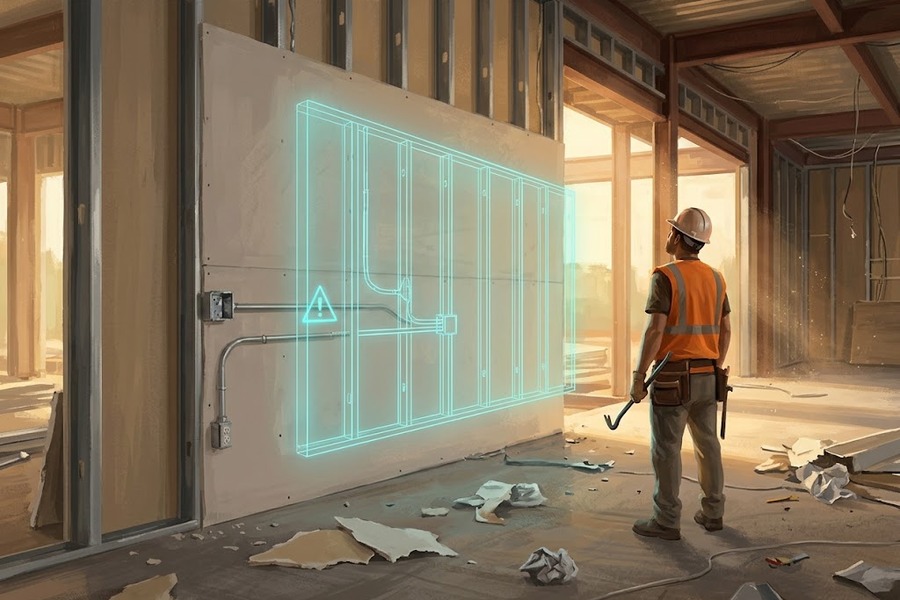
Ask construction firms what AI has done for them, and most will tell you it helps them see trouble sooner. Far fewer will tell you it has kept a crew from tearing out finished work.
That gap runs through Bluebeam’s 2027 AEC Technology Outlook, now in its third edition. Hanover Research surveyed 750 U.S. architecture, engineering and construction decision-makers for it. Among firms using AI, 64% credit it with greater cost predictability. Just 17% credit it with less rework.
Here’s what the research found, and where to dig in.
Why is rework construction’s most expensive problem?
Rework is where every upstream miss finally gets a price tag. A wrong dimension or a superseded sheet costs almost nothing to catch on a screen and a great deal to catch in finished work, which makes rework the yardstick any construction technology, AI included, eventually gets measured against.
Rework, tearing out and redoing work that was built wrong or built from outdated information, is one of construction’s costliest recurring problems. Research puts direct rework costs at about 5% of total construction cost, and closer to 9% once indirect costs and schedule effects are counted.
Those estimates come from U.S. studies weighted toward industrial projects, and rework is widely thought to be under-recorded. Rework originates in decisions made months before it surfaces on a jobsite, the report notes. It’s why so much effort goes into design review, and why it stings when the same errors keep slipping through.
What is AI doing for contractors?
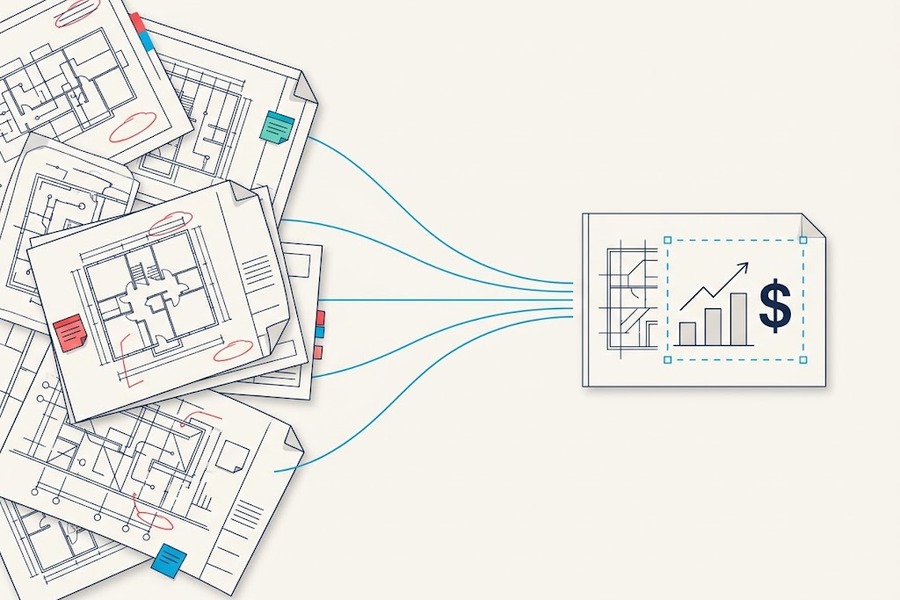
AI’s first real job in construction is turning out to be translation: taking the drawings, estimates and project data a firm already has and making them legible faster. That’s real progress for an industry that has long run on incomplete information, and it explains why the gains firms describe are about confidence rather than craftsmanship.
Mostly, AI helps firms know things sooner. Among the 448 U.S. firms using AI, 64% cite greater cost predictability, 58% earlier identification of risks and issues, and 55% reduced administrative burden. Reduced rework or late-stage changes ranks 11th of 12 benefits, at 17%.
All three mean better information earlier. That’s real value — getting ahead of risk is worth plenty. But an earlier warning doesn’t stop anyone from building the wrong thing. See all 12 benefits, ranked, in Section 5 of the report.
Where is AI being used on construction projects?
Where a technology lands first says a lot about what an industry is willing to risk on it. So far, construction has pointed AI at work where a bad output is cheap to catch and throw away, which is sensible caution and also a ceiling on how much rework it can touch.
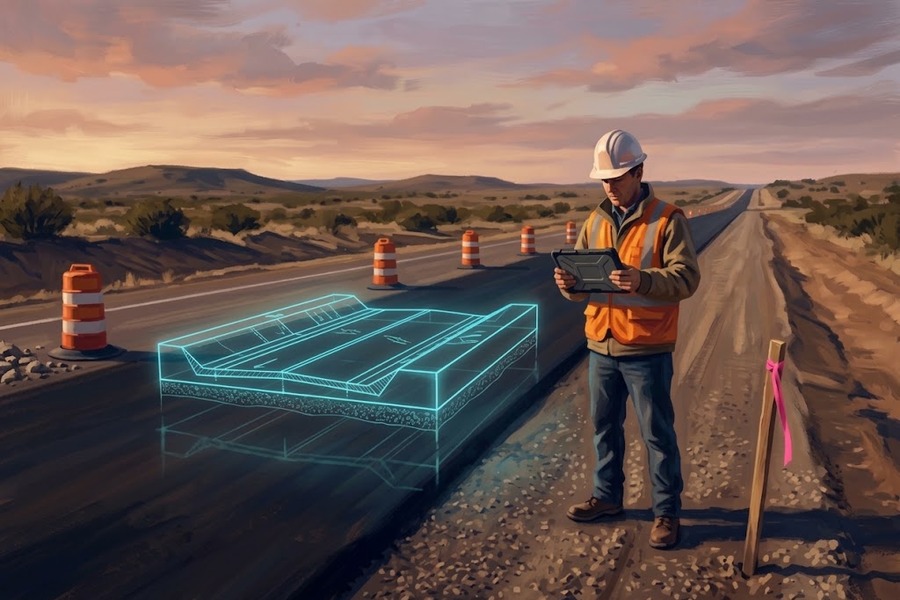
In the office, mostly before anyone breaks ground. Among U.S. firms using AI, cost estimation and design and modeling lead at 69% each, followed by project planning (63%) and document management (60%). Rework surfaces on the jobsite, far from where AI does most of its work.
Even in the office, most firms haven’t gone far. Just 28% of U.S. firms run AI in production, meaning it’s embedded across multiple core workflows (7%) or supports a few specific ones (21%). Another 32% are piloting, and 31% are exploring without having started. Section 3 breaks down all five stages.
Where do construction workflows break down?
Most construction technology has been built to make individual teams better at their own piece of the job. The costliest failures don’t live inside any one team’s piece though, and that mismatch between how tools are bought and how projects ultimately fail is the discreet story under this year’s data.
At the handoffs between people. Forty-one percent of U.S. firms cite the design-to-construction handoff and 41% the seam between office and field teams. Thirty-eight percent cite document management. Roughly four in five say disconnected tools substantially hurt decision speed, workflow efficiency and risk exposure.
That’s where a design decision fails to reach the crew building it or a revised sheet sits unopened during the hunt for the current drawing. The report also asks whether firms are using AI to connect their existing tools or to replace them. The answer cuts against a generation of software pitches. Section 7 has the numbers.
What separated the firms that scaled AI?
Scaling AI turns out to be less a technology decision than an operations one. The firms that made it work describe the hard part as fitting new tools into the way projects already run, a reminder that in construction, adoption is won in the workflow, not in the demo.
Integration. Asked what mattered most in moving AI past the pilot stage, 47% of the 210 U.S. firms that did it named integration with existing systems and tools. Next came cross-team collaboration (29%), transparency of AI results (27%), and high-quality data and employee training (26% each).
Near the bottom: strong leadership support (11%), a clear value or ROI case (12%) and adequate vendor support (10%). Firms could pick up to three factors and are describing their own success after the fact, so read a low rank as not chosen instead of unimportant. The full list is in Section 8.
As Bluebeam’s Jeff Sample, senior industry development manager for the trades, puts it in the report: “Nobody gets a plaque for connecting an estimating system to a document platform. That is the work though. The firms that got AI into production did the boring part first, and the boring part is why it stuck.”
More from the 2027 report
- Cost doesn’t separate stalled pilots from scaled firms: 50% of each name high implementation cost as a barrier. Section 4
- Digital tools proficiency is the skill firms prioritize most when hiring (93%) and the hardest to find (77%). Section 6 (One union school is already training electricians to work digitally before they reach the jobsite.)
- Forty percent of firms running AI in production estimate savings above $500,000. Section 8
- A separate edition covers 350 firms in Germany and Austria.
The industry has bought the ability to see problems sooner. What it hasn’t built yet is the path from seeing a problem to stopping it, and that path runs through handoffs, integration and people more than through better models.
Explore the full 2027 AEC Technology Outlook →