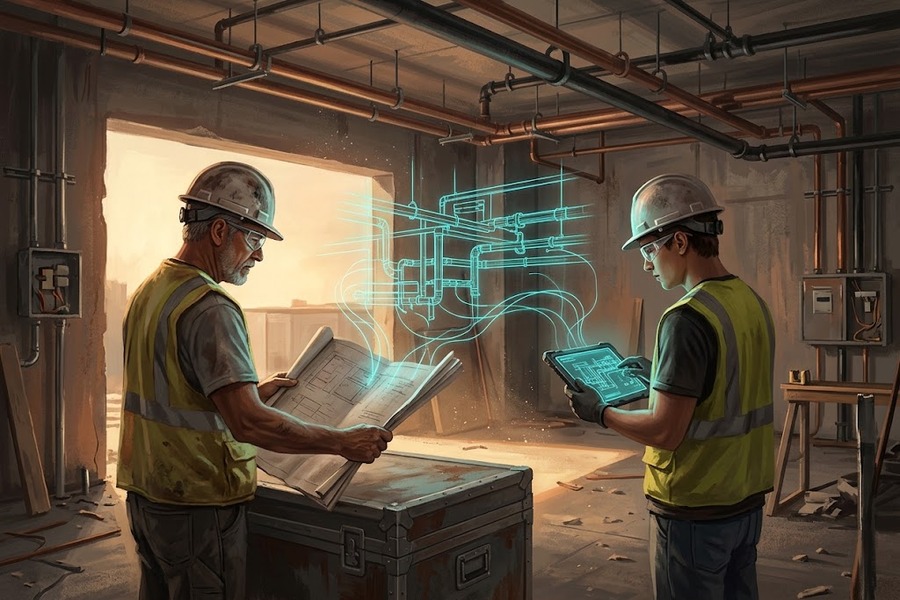
Most people who join the pipe trades do it for the same reason. They want to build things with their hands. Nobody signs up for a five-year apprenticeship dreaming about email etiquette or PDF markups.
Yet that’s increasingly part of the job, and the United Association is teaching it earlier than ever.
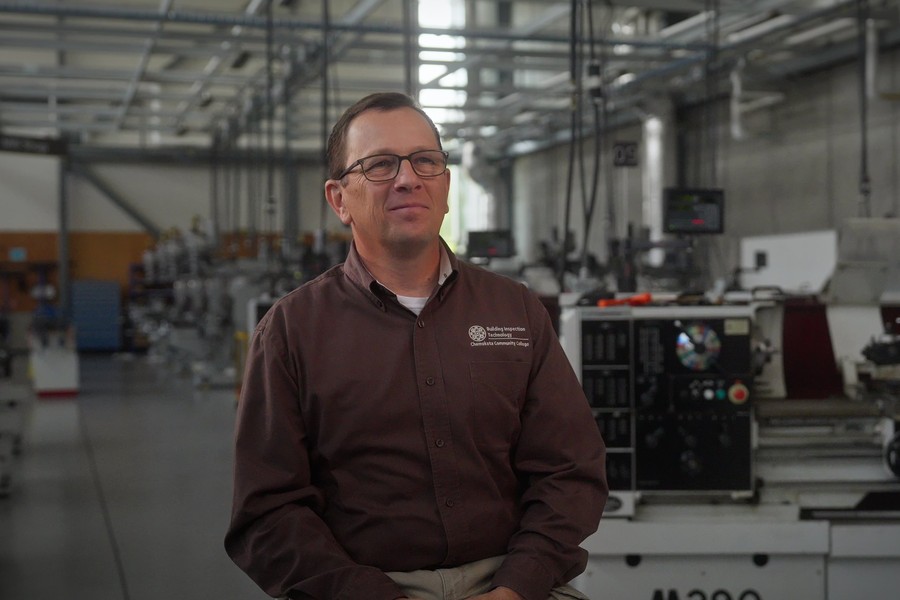
“We’re trying to move to the left of the apprenticeship,” says John Franke, a training specialist with the UA International Training Fund.
The UA represents more than 400,000 pipe fitters, plumbers, sprinkler fitters, welders and HVAC techs across the U.S. and Canada. It also runs more than 300 training centers, where members who use the same tools on the job teach the next generation. The union’s push to front-load digital skills lands squarely on one of the sharpest findings in Bluebeam’s 2027 AEC Technology Outlook, which surveyed 750 U.S. architecture, engineering and construction decision-makers: The skill firms want most in new hires is also the hardest one to find.
Why is construction’s workforce problem now about capability, not just headcount?
Hiring more people no longer closes the gap on its own. As projects lean on digital documents and fewer experienced hands, the bottleneck has shifted from how many workers a contractor can field to what each of them can do once they’re on site, and that is a training problem as much as a recruiting one.
Construction’s labor shortage used to be a numbers game: find enough people to staff the job. That math has changed. When experienced crews are stretched thin, every worker carries more of the project. The skills that make that possible, like print reading, marking up and moving information digitally, are the ones in shortest supply.
The survey data backs that up. Across the survey, 84% of respondents say their organizations have faced labor or skills shortages in the past year. Of those, 74% say shortages have increased workloads for existing employees, 49% report delayed project timelines and 62% say shortages are at least moderately limiting their ability to deliver projects.
The hiring picture is just as telling. Digital tools proficiency is the top skill U.S. firms prioritize when hiring, cited by 93%. It’s also the hardest to find, cited by 77%. AI-related knowledge ranks second on the hard-to-find list, at 59%.
Franke sees the digital skills gap from the training side. “It is a barrier, and it’s a challenge that we’ve been trying to address,” he says.
How is the UA building digital skills into a five-year apprenticeship?
An apprenticeship has always been how the trades pass on judgment along with technique. Folding digital work into that system puts screens and software under the same standard as any other tool on the truck: something a worker is expected to master before the job demands it.
The old model treated digital skills as something you picked up later if you moved into a foreman or office role. The UA is flipping that. It’s treating digital fluency as a trade skill in its own right, built in from the start, so apprentices are ready when the jobsite asks more of them.
The approach is gradual by design. Rather than a single technology course, the UA is layering skills across the full apprenticeship.
“It’s a five-year apprenticeship, where we’re just sprinkling in different skills,” Franke says. “Especially if you become more of a foreman or journey worker, the skills that you’re going to need on jobsites.”
Some of those skills are basic. “Things as simple as, how do you compose a professional email? How do you use the suite of Microsoft stuff?” he says. Others are closer to the work itself: “Opening up contract documents and prints in Bluebeam, being able to mark them up.”
What gets taught isn’t decided in a vacuum. The UA works closely with the Mechanical Contractors Association of America, whose signatory contractors employ UA labor. “They’re kind of our conduit to the contractors,” Franke says, “to make sure that we are training and providing what the contractors are seeing.” That matters because needs vary widely by region, depending on the resources contractors have and the work they do.
Why does digital training fall flat when it doesn’t match the job?
Crews keep what earns its place on a real shift and drop what doesn’t. That puts the burden on the curriculum: Training built around the documents and decisions workers already handle every day tends to stick, while training built around what software can do in theory rarely survives the next job.
Technology training has a relevance problem. Tradespeople judge a tool the way they judge a wrench: Does it do something I need today? Training that shows off features instead of solving real jobsite problems loses its audience fast, no matter how powerful the software is.
Franke has watched it happen. “If we’re just throwing a bunch of cool, fancy tools on them that they’re not going to use or see day to day, we find that we kind of lose their interest,” he says. “They kind of move it to the back burner and don’t really see the value.”
The fix is to start from the work. UA members hold a range of roles, from estimators and BIM/VDC leads to foremen and superintendents. So the UA is working with Bluebeam to condense existing training material into workflows members will ultimately use, and to make it “right fit for what our members are going to actually be using it for,” Franke says.
What happens when a journey worker and an apprentice share the same set of plans?
Knowledge transfer in the trades has usually run one direction, from old hand to new hire. Pairing tenured workers with apprentices on digital work makes it a two-way exchange, and it keeps hard-won field know-how in circulation as more of the people who hold it head toward retirement.
The generational divide in the trades is usually framed as a problem. On the jobsite, it can be an asset. Veterans bring judgment that takes decades to earn, while apprentices bring comfort with screens. Put them on the same drawings and each covers the other’s blind spot.
Franke says enthusiasm for digital tools varies. Younger apprentices who grew up with technology tend to gravitate toward it. Older, more tenured members can be less willing to engage.
So the UA leans into the pairing. “It’s kind of cool to have the more tenured person side by side with an apprentice, where they can be a dynamic duo,” he says. “You’ve got the trade knowledge with the older one, and then the younger apprentice who maybe does gravitate towards the technology side.”
For that apprentice, the learning curve is short. Hand them a tablet, Franke says, and they can “intuitively mark up, search through and find their way around.”
The common ground is print reading. It’s the core skill of the trade, and it’s the same skill whether the drawings are on a table or a tablet. The foreman may still work from a paper set while the apprentice works from a tablet, and they’re reading the same plans.
That pairing matters more as experienced workers retire and take their knowledge with them. Bluebeam CEO Usman Shuja calls the worker the industry needs a “dual athlete”: someone with deep trade expertise and digital fluency. For now, the UA is building that athlete two people at a time.
Can digital skills widen the door into the trades?
The trades’ recruiting problem is partly a perception problem: Plenty of people still see the work as all muscle and assume it has no place for someone drawn to screens and software. Digital skill corrects that picture, and it presents skilled trade work as the technical career much of it has already become.
The trades have spent years trying to recruit people who never pictured themselves on a jobsite. Technology may be the pitch that finally lands. A career that combines physical work with digital skill can reach people a hands-only pitch never did, and it offers more places to grow once they’re in.
Franke sees digital skills as both a retention tool and a recruiting one. “Layering on the technology and the digital side just opens it up to more people that maybe traditionally hadn’t considered a career in the trades,” he says.
Once they’re in, the paths multiply. “There’s just so many avenues that you can go into now,” Franke says. “If you have those skills and can leverage those, you’re just that much more powerful and can be more efficient in your day-to-day workflows.”
The work hasn’t changed. The toolbox has.
Pipe still has to be fit, welded and hung. Plans still have to be read right the first time. None of that is going digital.
What’s changing is everything around it: the markups, the documents, the handoffs between the field and the office. The UA’s bet is that apprentices who learn those skills early won’t have to choose between working with their hands and working with a screen. They’ll show up ready for both.
Frequently asked questions
What digital skills is the UA teaching apprentices?
The basics include writing a professional email and using Microsoft tools. Closer to the work, apprentices learn to open contract documents and prints in Bluebeam and mark them up. The UA spreads these skills across its five-year apprenticeship instead of saving them for later in a career.
What skills are hardest for AEC firms to hire for?
In Bluebeam’s 2027 AEC Technology Outlook, 77% of respondents said digital tools proficiency is the hardest skill to find in candidates. AI-related knowledge ranked second at 59%.
What is the UA International Training Fund?
It supports training for members of the United Association, which represents more than 400,000 pipe fitters, plumbers, sprinkler fitters, welders and HVAC techs in the U.S. and Canada. The UA runs more than 300 training centers and works with the Mechanical Contractors Association of America to keep training aligned with what contractors need.