Picture a superintendent on a commercial job, 10 weeks from substantial completion. They’re not behind on approvals or missing a deadline. They’re looking for a drawing.
Not a drawing that doesn’t exist. A drawing that does exist, somewhere, in one of four shared drives their team has accumulated across three years of project turnover. They find it 40 minutes later. It’s version 7, and they needed version 9.
Nobody budgeted for that 40 minutes. Nobody budgeted for the calls that followed, or the rework that came after. That’s the thing about document management failures: they don’t present as failures. They look like Tuesday.
The construction industry has built an entire operating culture around workflows that feel good enough — until you calculate what good enough is costing you. Bluebeam works with more than 4 million construction professionals worldwide, and this pattern shows up everywhere: in the data, on the jobsite, and in the stories crews tell about the moment they finally changed how their teams work.
Those patterns are confirmed by Bluebeam’s own research. The AEC Technology Outlook 2026, a global survey of more than 1,000 construction professionals published in October 2025, found that only 11% of AEC firms are fully digital across all project phases. The other 89% are still relying on paper, spreadsheets and legacy tools — especially in the field and during closeout, where document integrity matters most.
This piece makes the case for why that gap matters — in dollars.
Bluebeam’s Document Management for Construction 2026 Guide goes deep on what a modern document workflow looks like. What follows is the business case for why it matters.
The Gap Between ‘Digital’ and Actually Digital
Every firm in construction will tell you they’ve gone digital. In a narrow sense, most of them have. PDFs replaced paper; email replaced fax; shared drives replaced filing cabinets. That counts.
Still, digital tools and digital workflows are not the same thing. Nearly half of AEC professionals still rely on paper during design or handover, according to the AEC Technology Outlook 2026. Nearly 40% report challenges managing collaboration across the full project lifecycle, especially when crews are siloed between design, construction and operations. Meanwhile, 23% cite integration complexity as their top barrier to adoption — higher than cost, higher than time, higher than lack of leadership buy-in.
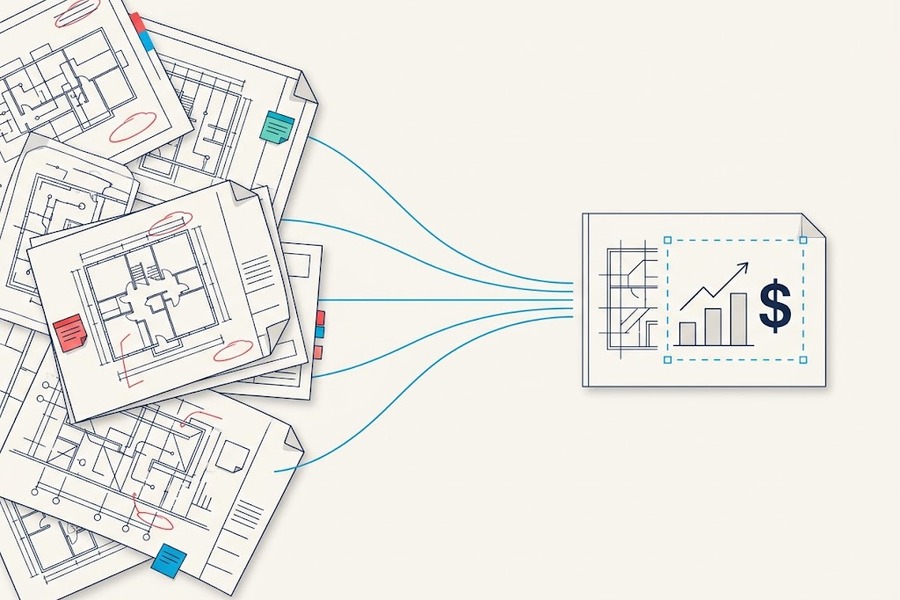
That partial digitization is exactly where the cost hides. The filing cabinet is gone, but the chaos it represented hasn’t been. It’s been distributed across inboxes, cloud folders, and markup files with names like “final_FINAL_v3_revised.pdf.” Field teams are hunting for information across systems that don’t talk to each other, and that hunt shows up on the job as wasted time, cost overruns and risk.
The tools are there. The connection between them often isn’t.
What 14 Hours a Week Costs
The most detailed look at where construction crews spend their time comes from the FMI and PlanGrid “Construction Disconnected” study, a 2018 survey of nearly 600 construction leaders. The finding that should stop any PM cold: construction professionals spend 35% of their time — more than 14 hours a week — on what the study called “non-optimal” activities. Hunting for project data; resolving conflicts; dealing with rework. In other words, not building or managing. Looking.
The breakdown is worth sitting with. Of those 14-plus hours, 5.5 go to chasing down project information. Another 4.7 go to conflict resolution. The remaining 3.9 go to mistakes and rework. Across the US construction workforce, that wasted time carries an estimated annual labor cost of $177.5 billion.
That figure is specific, to be sure, to 2018 dollars and one methodology. Yet the directional argument holds regardless: when your most experienced people are spending a third of their week chasing information rather than making decisions, you’re paying a tax on every hour you’ve hired them. That tax doesn’t show up on any job cost report.
Rework, RFIs and the Paper Trail Nobody Wanted
The time loss is real. Yet it’s the downstream consequences that turn an efficiency problem into a business problem.
Start with rework. The Construction Industry Institute’s field rework research, drawn from a database of 144 industrial projects, established the benchmark the industry still cites: direct rework costs run about 5% of total construction cost. That figure understates the actual hit because rework is systematically underreported — roughly a third of the project teams CII surveyed believed their recorded rework captured only 50% to 75% of what occurred.
What’s more, the 2018 FMI and PlanGrid study put a dollar figure on it: $65 billion of US construction spending goes to rework annually, and $31.3 billion of that — 48% — traces back to poor communication and bad project data. Not bad workmanship. Bad information.
The broader picture is starker. A 2021 Autodesk and FMI study estimated that inaccurate, incomplete or inaccessible project data cost the global construction industry $1.85 trillion in 2020, driving $88.69 billion in rework alone. Thirty percent of respondents said more than half of their project data was “bad” in some way — inaccurate, outdated, inaccessible or entered twice.
Then there are RFIs. A Navigant Construction Forum analysis of roughly 1.1 million RFIs across 1,362 projects found that the average project in the sample generated 796 RFIs, each costing an estimated $1,080 to review and respond to. That works out to about $860,000 per project in RFI processing alone.
The median response time in the analysis, meanwhile, was 9.7 days. And roughly 22% of RFIs never got a response at all — a rate Navigant called a leading indicator of deeper trouble, from an overwhelmed response system to no real controls over how RFIs get processed in the first place.
Change orders add another layer. An AIA analysis of nearly 900,000 change orders across more than 18,000 completed US building projects found that change orders average 4% to 5% of contract value, with the top of the typical range running about 15%.
More useful than the average, though, is the timing: most change orders land in the back half of a project, and AIA found that the later one arrives, the fewer options an owner has and the more it tends to cost.
This is another way of saying the expensive changes are the ones nobody saw coming — because the information that would have surfaced them was sitting somewhere no one could reach.
None of these, to be clear, are acts of God. They’re what happens when crews on the same job are working from different versions of the same information.
The Productivity Gap That Makes It Worse
The document management problem doesn’t exist in isolation, either. It sits inside a broader productivity problem that construction has been living with for decades.
McKinsey Global Institute’s 2017 analysis found that global construction labor productivity had grown only 1% per year over two decades, compared to 2.8% for the total world economy and 3.6% for manufacturing. In the US, construction labor productivity is lower today than it was in 1968.
A 2023 McKinsey update found that construction productivity improved only 10% between 2000 and 2022 — while the broader economy improved 50% and manufacturing improved 90% over the same period.
That stagnation has many causes, and document management is one of them. When nearly a third of a crew’s week goes to finding and reconciling information, no technology investment fully compensates for it. The workflow has to change.
Bluebeam’s Document Management for Construction 2026 Guide lays out what that change looks like in practice — from version control protocols to real-time collaboration workflows to closeout documentation that doesn’t require a four-month archaeological dig.
Why the Math Is More Urgent Now
The inefficiency was always there. What’s changed is the margin available to absorb it.
GC net margins sit around 5%-6% in a good year, and about one in six contractors say they’ve absorbed recent cost increases themselves rather than pass them through — a strategy that works until it doesn’t.
Meanwhile, construction wages rose 4.2% year over year as of August 2025, and Associated Builders and Contractors estimated the industry needed to attract 439,000 workers in 2025 alone — a number it raised to 499,000 for 2026.
Effective tariff rates, moreover, on construction goods hit a 40-year high of 25% to 30% in 2025, according to Deloitte’s 2026 Engineering and Construction Industry Outlook. AGC’s producer price data shows what that did downstream: aluminum mill shapes up 30.5% across 2025 and steel mill products up 17%, the steepest increases since 2022. Total US construction spending, meanwhile, was down almost 3% year over year by July.
When every cost input is moving the wrong way at once, self-inflicted costs start to matter in ways they didn’t when margins were thicker. Rework that was a nuisance at 12% margin can be existential at 5%. RFI delays that were an annoyance on a fully staffed project become critical path issues when you’re already shorthanded.
There’s a workforce dimension, too.
The AEC Technology Outlook 2026 found that 44% of firms say advanced technology plays a key role in attracting and retaining workers, alongside culture and pay. In an industry already facing a serious labor shortage, document chaos isn’t just an efficiency problem; it’s a recruiting problem. Younger workers notice when they’re handed outdated systems on day one.
The firms absorbing these costs without fixing the underlying workflow aren’t just losing money on individual jobs. They’re building structural disadvantages into how they operate.
What Good Looks Like
The answer isn’t another tool, but a different way of working. The firms that have made the change are producing results that show up on the bottom line.
Consider DPR Construction’s experience on the Alta Bates Summit Medical Center project in Oakland. Facing a 31-day schedule delay and an accelerated rebar fabrication timeline, DPR turned to Bluebeam Studio Sessions to run simultaneous, real-time collaborative reviews with the engineer of record and rebar detailer.
By reviewing and resolving shop drawing issues in a live session rather than passing PDFs back and forth, the team cut the submittal review cycle by more than 33% — compressing a 25-to-30-workday process into a 10-to-12-day window. That’s up to 10 days of schedule recovery per review cycle, on a project where every day had a dollar figure attached to it.
The results at Balfour Beatty’s DFW Airport renovation tell a similar story: $5 million in project savings attributed to centralizing documents and giving field teams real-time access to the information they needed, when they needed it. The savings didn’t come from a technology initiative; they came from fixing how information moved through the project.
Those aren’t outliers. They’re what Bluebeam sees when firms close the gap between having digital tools and ultimately running digital workflows. Among the 27% of construction firms currently using AI tools, 68% report saving at least $50,000 on recent projects, and 46% have saved 500-1,000 hours by applying AI to scheduling, planning and document analysis, according to the AEC Technology Outlook 2026.
What the firms getting these results have in common isn’t a particular software stack. It’s a single source of truth for project documents, accessible to every stakeholder in real time. It’s markups that are tracked, versioned and auditable — not living in email attachments. It’s RFI and submittal workflows that move in hours, not days. It’s a closeout process that doesn’t require assembling a package from five different places at the end of a job.
Bluebeam is built specifically for this kind of work — document-based collaboration that spans disciplines, formats and project phases without requiring firms to overhaul their entire tech stack. Bluebeam Max brings together markup, collaboration and project management in a single platform built for AEC workflows from design through closeout. Bluebeam’s customer stories offer a closer look at what these workflows produce in practice across firms of every size and type.
The Question Worth Asking
There’s no line item on a job cost report for “time spent looking for the right drawing.” There’s no budget category for “rework caused by working off the wrong version.” These costs are real, recurring and largely invisible — which is exactly why most firms haven’t done the math.
The math, when you do it, is uncomfortable. Hundreds of thousands of dollars per project in RFI management alone. Five percent of project value in rework, half of it caused by bad data. More than 14 hours a week per worker spent on things that aren’t building anything. Across a firm’s project portfolio, those numbers stop looking like friction and start looking like a structural problem.
The firms winning in this market — on thinner margins, with tighter crews — haven’t found ways to absorb those costs. They’ve found ways to stop incurring them.
If your team is working harder than the project warrants, the answer might be in how your documents are — or aren’t — moving. Bluebeam’s Document Management for Construction 2026 Guide is a good place to start that conversation.