A lot of money is going into building data centers faster. The Wall Street Journal on Sept. 1 catalogued six of the techniques doing it, with reported time savings running from a few hours to six months.
Bloomberg, using data from the market research firm Sightline Climate, reported that of roughly 12 gigawatts of U.S. data center capacity slated for 2026, only about a third was really under construction. The reasons cited: shortages of transformers, switchgear and batteries.
Plenty of people have strong opinions about the buildout. Set those aside. The work is being bid and built right now, and it asks something different of the trades than the work before it.
What are the six techniques speeding up data center construction?
Six unrelated products from six unrelated companies. Read them as a group and one strategy shows up. Speed is not coming from anyone working faster on site. It comes from decisions moved upstream, out of the field and into a shop or a spec.
Three land directly in electrical scope.
The drilling robot. DEWALT and August Robotics launched it this year reporting 99.97% accuracy across more than 90,000 holes. It drills anchors for server rack stops and the structural legs carrying overhead MEP. That robot sets the geometry your hangers land on.
The connectors. 3M’s expanded beam technology cuts plug-up from roughly three minutes per connector to as little as 30 seconds, across hundreds of thousands of them. Connection speed stops mattering if you connected the wrong thing quickly.
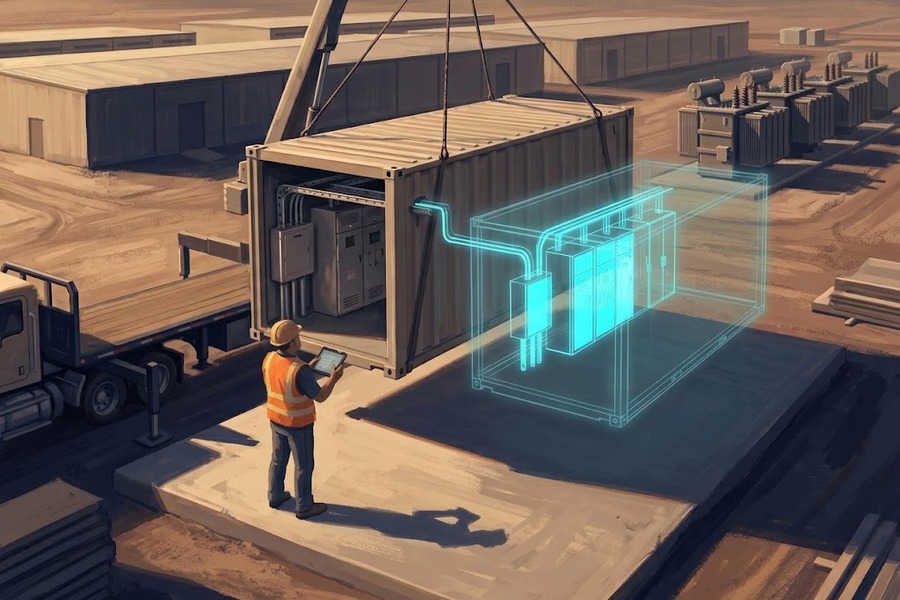
The factory-built rooms. The big one. Rooms get assembled in a plant, trucked in and set. Your coordination package is no longer a guide for a crew. It is an input to a production line.
Every shortcut there buys schedule certainty by giving up flexibility, and flexibility is what the field has always used to make imperfect drawings work. None of that hurts when the information is right. All of it hurts when the information is wrong, because the correction that used to happen on a Tuesday afternoon now happens on a truck.
How much of a data center’s cost is electrical work?
Data centers are not big office buildings with more outlets. On this work the electrical scope has moved from a supporting line on the cost sheet toward the center of it, which changes who carries the risk when something goes wrong and how much leverage the trade has at the table.
On an AI data center, electrical is the biggest line on the cost sheet. Turner & Townsend’s 2025 data center cost index puts electrical systems at 48% to 54% of construction cost, ahead of mechanical, and several times the shell. The inputs are getting more expensive, too: copper wire is up 17.9% from a year ago.
The International Brotherhood of Electrical Workers estimates 45% to 70% of the construction budget goes to the electrical subcontractor. That covers the sub’s full scope rather than one line on a cost sheet, and the union publishes it without showing its math. Still, a cost consultant and the electricians’ union, measuring different things, land in the same place: roughly half the job.
Electrical and power share of construction cost
| Project type | Electrical/power share | Source |
| Typical commercial building | 15% – 20% | Industry baseline |
| AI data center (2018) | 28% – 32% | CBRE, JLL cost-stack analyses |
| AI data center (current) | 35% – 45% | CBRE, JLL cost-stack analyses |
| AI data center, full electrical sub scope | 45% – 70% | IBEW estimate |
The IBEW figure measures the electrical subcontractor’s entire scope rather than a single line on a cost sheet, which is why it sits well above the CBRE and JLL numbers.
Why can’t electrical mistakes get fixed in the field on these jobs?
On most work, rework is a cost line. Somebody eats it and the job moves. On this work that tolerance is mostly gone, and the reason has less to do with craftsmanship than with what the building does once it is energized.
Chris Doyle has been in the trade since 1988 and works as a detail manager at Redwood Electric on an active data center project in Reno, Nev. The work has not only grown in volume, he said. It has raised the technical floor, “from single lines to ladder logic and the understanding of how these systems are supposed to work.” Not only for the people running jobs. “That’s the people that are building it.”
“At the end of the day, if there’s any mistakes in a UPS system, you’re talking about millions of dollars in downtime. The bar is very, very high, not just because we as an institution here want it to be, but because that’s what the industry demands.”
Most rework was never a field execution problem to begin with.
- A Construction Industry Institute study of industrial projects found design changes, errors and omissions drove 79% of the cost of quality deviations. Construction deviations drove 17%.
- A 2018 FMI and PlanGrid survey traced 48% of U.S. rework to poor project data and miscommunication, about $31.3 billion that year.
The field has spent decades absorbing mistakes made upstream. Prefab takes that away. The errors don’t stop. The shock absorber does.
The standards are still catching up. IEEE authorized Project P3710 in June 2025 to write design guidance for modular data centers, and it is still in development. The NEC and UL frameworks everybody works under were written for equipment installed in place, not built in a plant and shipped.
We have written before about what a 40-minute drawing hunt costs and why projects run late for reasons that have nothing to do with weather.
What’s really slowing down data center construction?
The six techniques all attack labor hours on site. Neither of the two things ultimately gating these projects lives there. Equipment and qualified people are procurement problems, not productivity problems, and no amount of speed in the field moves either one. Both get decided long before a crew mobilizes.
Gear. Wood Mackenzie’s Q2 2025 survey put power transformers at 128 weeks and switchgear around 44. Its 2026 read, reported by Data Center Knowledge, has substation transformers past 160 weeks, up from roughly 140 in 2023.
Electrical equipment lead times
| Equipment | Lead time | As of | Source |
| Power transformers | 128 weeks | Q2 2025 | Wood Mackenzie |
| Switchgear | ~44 weeks | Q2 2025 | Wood Mackenzie |
| Substation transformers | ~140 weeks | 2023 | Wood Mackenzie via Data Center Knowledge |
| Substation transformers | 160+ weeks | 2026 | Wood Mackenzie via Data Center Knowledge |
Wood Mackenzie’s most recent per-equipment survey is from Q2 2025. Its 2026 substation transformer figure was reported by Data Center Knowledge.
Lead times are cyclical and will come down. Distribution transformers already have, falling from more than 100 weeks in 2023 to about 30. Schneider Electric announced in March 2025 it will invest more than $700 million in U.S. operations through 2027, including switchgear and medium-voltage production. Shorter lead times still do nothing to restore the ability to adjust a prefabricated room after it comes off the truck. The shortage is a cycle. Front-loaded risk is a change in how the work gets built.
People. Google’s May 2025 white paper “Powering a New Era of American Innovation” reports that nearly 10,000 American electricians retire or change careers each year against about 7,000 new entrants.
The Bureau of Labor Statistics counted 818,700 electricians in the U.S. in 2024, projects 9% employment growth through 2034 and expects about 81,000 openings a year.
Watch what the companies with the most riding on these things are doing about it. Google.org funded the electrical training ALLIANCE, the joint IBEW-NECA apprenticeship organization, targeting 100,000 electrical workers and 30,000 apprentices. Siemens set a goal of bringing 200,000 electricians and manufacturing experts into the workforce by 2030.
One company doing that is a press release; two is a signal about which input is hardest to source. The money is going to apprentices, not another robot.
What should electrical contractors change to win this work?
The answer to industrialization is not working faster. Rather, it is refusing to rebuild the same thinking on every job while everything around you gets standardized. The firms that will hold margin here are the ones treating their own process as an asset with a version number, not something reassembled from memory each time.
Doyle argues data centers are more alike than most projects. “There’s an execution that can be about 80% the same,” he said. “So we shouldn’t have to start at zero like most projects tend to.”
The industry is moving his way. The Open Compute Project is building standardized reference designs for AI data centers, and Google contributed the first one, a facility design built around its TPU systems. But OCP’s own leadership describes the first wave of AI data centers as siloed, built with little coordination between vendors. The repeatable share runs high inside one customer’s program and lower across customers.
That tells you where to aim. The roughly 20% that does not repeat is where the job is won or lost, and the only way to have capacity left for it is to stop re-solving the 80%.
For an electrical sub, four habits:
- Build tool sets once and reuse them, so takeoffs start from your standard, not from scratch.
- Verify before release, not on arrival. Anything headed to a fab shop gets checked while changing it is free.
- Treat submittals and RFIs as schedule work, not paperwork handled between other things.
- Catch the conflict in design review while it is still a markup, because the field can no longer catch it for you.
The part that can’t be prefabricated
The pouring, the coating, the drilling, the connecting, all of it is getting faster and further from the hands that used to do it. The judgment that has to happen before any of it starts has not moved.
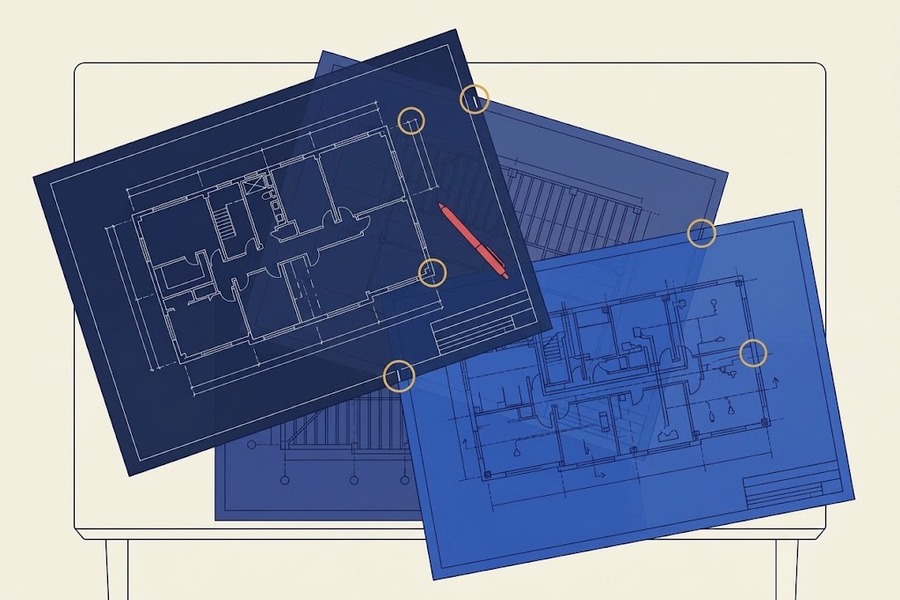
Somebody still has to know the drawing is wrong: that the anchor pattern doesn’t match the rack layout; that the routing won’t clear the structure; that the gear on the submittal isn’t the gear on the plan.
That work is getting more valuable, not less. The trades who do it consistently and can prove it get the calls.
Frequently asked questions
What percentage of data center construction cost is electrical work?
Turner & Townsend’s 2025 data center cost index puts electrical systems at 48% to 54% of construction cost, the largest single category. The IBEW estimates 45% to 70% measured as the electrical subcontractor’s full scope. Both figures exclude servers and IT equipment, which make electrical a much smaller share of total project cost.
How long are transformer and switchgear lead times in 2026?
Substation transformer lead times passed 160 weeks in 2026, up from roughly 140 weeks in 2023, according to Wood Mackenzie as reported by Data Center Knowledge. Wood Mackenzie’s most recent per-equipment survey, from Q2 2025, put power transformers at 128 weeks and switchgear at about 44.
Why is prefabrication riskier for electrical contractors on data center projects?
Factory-built assemblies lock decisions in before the crew arrives, so a drawing error the field once fixed with a Tuesday afternoon adjustment has to be caught before the assembly ships. That matters because most rework starts upstream: research from the Construction Industry Institute and from FMI traces it largely to design errors, changes and poor project data rather than field execution.
Is there a shortage of electricians for data center construction?
The Bureau of Labor Statistics counted 818,700 electricians in 2024 and projects about 81,000 openings a year through 2034, many from retirements and career changes. Google.org is funding an IBEW-NECA effort to train 100,000 electrical workers and 30,000 apprentices, and Siemens set a goal of adding 200,000 electricians and manufacturing experts by 2030.
Bluebeam builds software for specialty contractors, MEP trades and energy and infrastructure teams. See how AI-assisted drawing review changes what gets caught before the truck shows up.