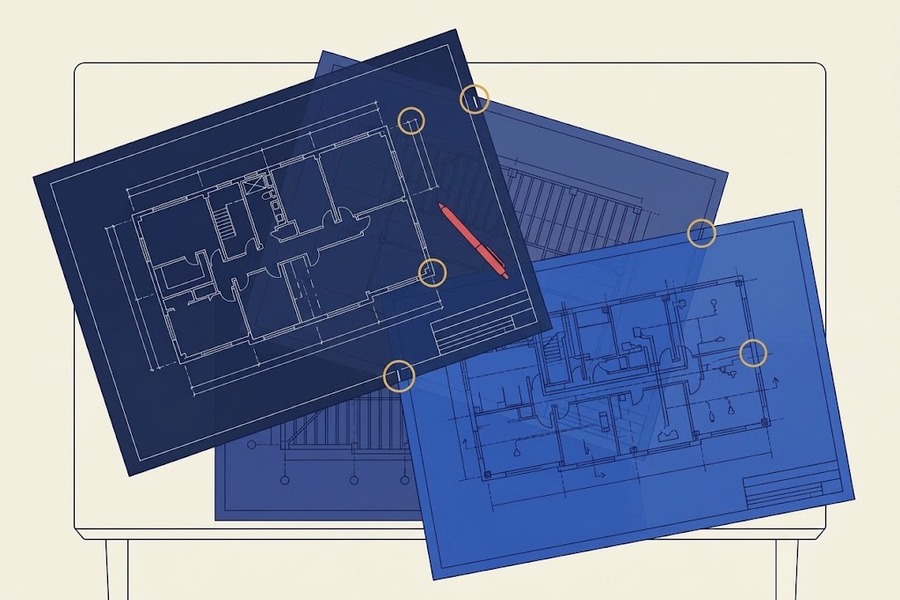
Sometime around 2018, Jean-Pierre Trou sat down at his dining room table in Austin, Texas, with 250 pages of drawings and a red pen. Three stories, 90,000 square feet, architectural plans stacked against structural and MEP. The review took him a week. We wrote about that table.
Anybody who’s done that work knows how it goes. You’re sharp on sheet 12. You’re a different reviewer by sheet 240.
The errors that get through are almost never the hard ones.
Why do the same drawing errors keep showing up?
Reviewer attention is a budget, not a switch. The industry treats a missed dimension as a discipline problem and answers it with more checklists and sets of eyes. The research on how people search points somewhere else, at a failure that shows up in any job built on hunting for something rare.
Ask why a missing door tag reached the field, and you’ll get some version of somebody should have caught that. Yet there’s a better answer: The errors get missed because they’re rare, and rare is where trained eyes fail.
Start with the airport. In a visual search study published in Nature, people missed 7% of targets when the target turned up in half the images. Drop it to 1% of images and misses jumped to 30%. Same people, same task. The only change was how often there was something to find.
That’s the problem with a clean set. Two hundred good sheets teach you the next one is good too, so you stop looking a little sooner each time. You’re not scanning worse, just quitting earlier.
Then there’s the study that should bother anyone who reviews drawings for a living. Researchers asked 24 radiologists to hunt for lung nodules in CT scans and dropped an image of a gorilla into the last case, 48 times bigger than the nodules they were hunting. Eighty-three percent didn’t see it. Eye tracking showed most of them looked right at it.
That one gets thrown around as proof that experts are no better than anybody else. The authors drew a narrower conclusion. Even expert searchers, working in their own field, are vulnerable to this. Their attention was tuned to nodules, which is why a gorilla didn’t register. As one of the researchers later put it, these weren’t bad radiologists, just human ones.
Nobody has run this test on a drawing set. The mechanism carries. The proof doesn’t.
Stack that on real volume. At workplace design firm Oktra, a drawing pack runs about 60 sheets and passes 100 with subcontractor drawings in, through roughly eight rounds of design review, with comments coming from design, coordination, cost, the client and suppliers.
What are the most common errors found in construction design review?
Most design errors aren’t exotic. They fall into a handful of shapes that repeat from job to job, which is what makes them worth naming out loud. A reviewer working a short list of known shapes is doing something different from one reading every sheet with the same attention and the same fatigue.
The research sorts these by cause. The UK’s Get It Right Initiative traces a large share of construction error back to design that is uncoordinated, incomplete, late or miscommunicated, and its design guide is built around fixing that upstream. Useful if you run a firm.
On the sheet, at 9 p.m., it looks like this.
| The error | What you’re looking at | What it turns into |
| Dimension conflicts | The same element dimensioned two ways on two sheets | Whichever sheet the field reads first becomes the building |
| Missing or wrong tags | Doors, fixtures or equipment on the plan but not the schedule | A submittal for something nobody can identify |
| Gridline mismatches | Structural and MEP working off grids that don’t agree | A clash nobody modeled |
| Missing sheets | A detail callout pointing to a sheet that isn’t in the set | An RFI on day one of the trade’s work |
| Spec-to-drawing conflicts | The drawing says one product, the spec says another | Somebody prices the wrong one |
| Scope gaps | Work sitting in the seam between two packages | Both trades assume it belongs to the other |
| Revision drift | A change that landed on one discipline’s set and not the rest | The set is current and wrong at the same time |
These stick around. A 2019 study of BIM coordination on two public projects found 67% of design discrepancy issues, and half of repeated clashes, still open when construction finished. They don’t just happen. They survive.
The last two are process failures wearing a drawing problem’s clothes. Comments scatter across email and meeting minutes, versions blur and markups get repeated. Oktra’s answer was one authoritative markup set for every downstream use. “If we’re going to review something, we do it properly once, not three different times for three different audiences,” Creative Director Jenny Edwards told us. Keeping the set straight is a document management problem, and it feeds everything downstream.
Which of these needs a human?
The useful split isn’t hard vs. easy. Rather, it’s whether a question has one right answer or takes somebody who knows how the building goes together. That line decides what belongs to software and what stays with a person, and it’s where most review time gets spent in the wrong place.
Four of the seven have exactly one right answer.
- A tag matches the schedule or it doesn’t.
- A grid aligns or it doesn’t.
- A referenced sheet exists or it doesn’t.
- A revision landed on every set or it didn’t.
None of that takes field experience, and every one is rare on any given sheet, which is where the search research says people fall down.
The other three need somebody who’s built something. A spec-to-drawing conflict is often an ambiguity, not a mismatch. A scope gap depends on how the work gets sequenced. Those are judgment calls, and judgment is what a reviewer should spend the good hours on.
Why this took so long to automate comes down to what a drawing is. A square might be a wall. It might be a table. You know which because you know what you’re looking at. Software didn’t. Tech entrepreneur Shir Abecasis made the longer case in AI Can Read Your Specs. But Can It Read Your Drawings?.
That’s where the tools have landed. In Bluebeam Max, Smart Review scans the set for the tag, sheet and gridline family. Smart Overlay flags changes across disciplines and drawing scales, which is revision drift, handled directly.
What changes when the first pass isn’t manual?
The value of catching an error early is easy to assert and hard to prove, which is why the numbers around rework are so unreliable. What changes when the scanning gets handed off has less to do with hours saved than with what a reviewer can put their name on.
Start with a number that cuts against the pitch. Peter Love has spent two decades studying rework. This year he went into a contractor’s actual cost records and found rework before completion averaged 0.38% of contract value, or 0.76% counting post-completion fixes. He notes the rework costs reported in the literature vary widely, depending on who is defining rework and how they are counting it.
The gap is the story. Nobody knows what this costs, including the people paying for it.
Downstream is easier to see. Navigant’s study of 1,362 projects and roughly a million RFIs found 9.9 RFIs per $1 million of construction cost, with a median 9.7 days to get an answer. Every one of those is a question somebody had to stop and ask.
Two caveats. That data is from 2013 and skews toward Australia and New Zealand, and Navigant’s own warning holds. A high RFI count doesn’t by itself prove the design was bad.
What teams report has less to do with hours. Rudolph and Sletten completes preconstruction reviews 30% faster running them in Studio. CannonDesign managed design review on a $2 billion hospital, which is the volume problem in its purest form.
Steve McElwee, director of construction at Foresight Custom Homes, put it in bid terms. AI reviewing the drawings alongside your own process lets you bid more accurately, knowing nothing slipped through.
The part nobody says out loud
Nobody in this business expects a perfect set. Ask any architect whether one exists and watch the reaction.
That’s not a complaint so much as the premise. If the set was never going to be perfect, catching things is the whole job, and the boring half of that shouldn’t depend on somebody being as sharp on sheet 240 as on sheet 12.
The table is still where quality control happens. The complete guide to construction design review covers the rest of the workflow, and the design review and QA/QC workflow page covers how it runs in Bluebeam.
Frequently asked questions
What are the most common errors found in construction design review?
Seven categories account for most of them: dimension conflicts between sheets, missing or inconsistent tags, gridline mismatches across disciplines, missing sheets and dead references, spec-to-drawing conflicts, scope gaps between trades, and revision drift where a change reaches one discipline’s set but not the others.
Why do experienced reviewers miss obvious drawing errors?
Because the errors are rare. Visual search research shows miss rates climb sharply as targets become less frequent, and a study of 24 radiologists found 83% failed to notice a gorilla image inserted into a CT scan while hunting for lung nodules. The authors concluded that even expert searchers, working in their own field, stay vulnerable to missing what they are not looking for.
Can AI catch design errors before construction starts?
It can catch the deterministic ones. Tag mismatches, gridline inconsistencies, missing sheets and unpropagated revisions are rule-checkable, and software doesn’t get tired at sheet 240. Conflicts that require reading design intent, like an ambiguous spec-to-drawing discrepancy or a scope gap between trades, still need a person. Bluebeam Max runs the first pass with Smart Review and Smart Overlay.
Does a high RFI count mean the design was bad?
Not on its own. Navigant’s research found roughly 9.9 RFIs per $1 million of construction cost across 1,362 projects, and cautioned that a high RFI count does not by itself indicate defective plans. Treat RFI volume as a signal worth investigating rather than a verdict on the design.