
The slab measured 185 cubic yards. The truck delivered 195.
Somewhere between those two numbers, someone made a decision. Maybe it was a 5% waste factor. Maybe it was pump priming and a subgrade that came in uneven. Maybe it was a purchasing manager who has been burned before and rounds up on principle. Any of those is defensible. What is not defensible is not knowing which one it was.
That gap, the 10 yards nobody can account for, is what happens when quantity takeoff, material takeoff and cost estimate get treated as the same activity. They are three distinct steps with three different owners doing three different jobs. Blurring them does not just muddy the paperwork. It costs you the ability to defend a number six months later, when the person asking is a project manager and the answer had better be good.
Why do three different jobs share one name?
The vocabulary drifted because the work compressed. When one person measures, adjusts for waste and prices in a single sitting, the language stops distinguishing steps that used to belong to separate desks. The terms did not become interchangeable. The workflow simply stopped making the seams visible.
There was a time when these three documents were produced by three different people, often in three different rooms. A takeoff clerk measured. A purchasing agent turned those measurements into orders. A chief estimator applied pricing and decided what the number would be. The handoffs were physical, so the distinctions were obvious.
Digital workflows collapsed that sequence onto one screen, and, in most firms, onto one person. That is a real productivity gain. It is also how the language got sloppy. Add the fact that “takeoff” works as both a verb and a noun, and that most software in this category is marketed as “takeoff and estimating,” and you end up with an industry using one word for three jobs.
The confusion is a language problem. The consequences are not.
What does a quantity takeoff establish?
The quantity takeoff is the only layer of an estimate that does not belong to anyone’s judgment. It belongs to the drawings. That is the source of its authority, and the reason it has to stay unnegotiated. The moment an estimator’s opinion enters the measurement, the number stops being evidence and starts being an argument.
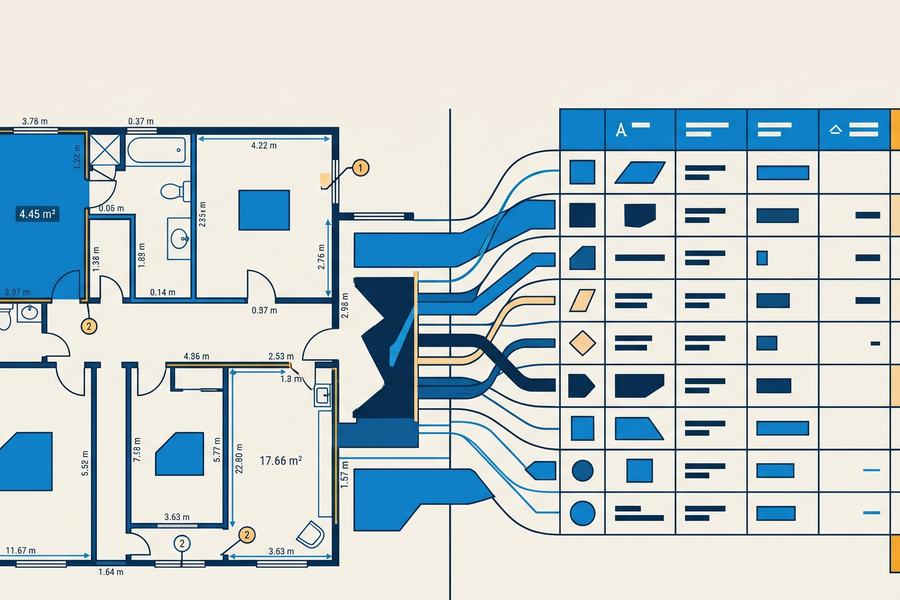
A quantity takeoff (QTO) measures the net in-place quantities required to build the project as designed. Lengths, areas, volumes and counts, captured directly from the construction documents, with no adjustment for waste, packaging or field inefficiency.
Square footage of flooring shown on the plan. Cubic yards of concrete defined by slab thickness and footprint. Fixture counts pulled off the reflected ceiling plan. The QTO is the project’s geometric truth, and it answers exactly one question: What exists on paper?
A clean QTO leaves four things out on purpose:
- Waste factors for cuts, spillage and breakage
- Packaging logic, standard sizes and order minimums
- Labor productivity assumptions
- Any form of pricing
The test is not whether the total feels right. It is whether a second estimator, handed the same sheet set, would land on the same number and be able to see how you got there.
The QTO defines scope, not strategy. Nothing about how you plan to buy the material, sequence the work or price the job belongs anywhere near it.
How is a material takeoff different?
A material takeoff is the first place construction reality gets a vote. Waste, breakage, standard sheet sizes and the uneven subgrade nobody drew are all legitimate inputs, and they all reflect somebody’s experience rather than the drawing set. That is precisely why they need their own container instead of being folded into the measurement.
The material takeoff (MTO) builds on the QTO but answers a different question: What do we need to buy?
This is where net quantities become gross quantities. Waste factors for cuts, spillage and breakage. Packaging and standard sizes, because drywall comes in sheets and rebar comes in lengths. Overlap allowances for roofing and siding. Overage for constructability, including the pump priming and the subgrade variability that turned 185 yards into 195.
The MTO is a procurement tool. It supports purchasing, logistics and delivery planning. It is not a bid comparison document, and it is not a scope validation document. Treating it like one is how contractors end up bidding their own waste factors, paying markup on the same material twice: once in the volume and again in the unit price.
A clarifying way to think about it: Two contractors bidding the same job should produce nearly identical quantity takeoffs and meaningfully different material takeoffs. The QTO reflects the design. The MTO reflects the builder. If two QTOs disagree, somebody misread the drawings. If two MTOs disagree, that is just two companies with different suppliers, different crews and different tolerances for running short.
Where does the cost estimate fit?
Pricing is the layer everyone watches and the layer with the least power to fix anything. A sharp unit cost applied to a wrong quantity produces a confident, well-formatted mistake. The estimate inherits whatever the takeoff got wrong, and no amount of discipline downstream can reach back upstream and repair it.
The cost estimate is where quantities meet money. Unit prices, labor productivity rates, equipment costs, indirect costs, general conditions, contingency and profit. This is the step that produces the number you submit and then live with for the next 18 months.
No amount of pricing accuracy can fix bad quantities. If the takeoff is wrong, the estimate will be wrong, whether it comes in high or low. The quantity takeoff is the independent variable. Every other number in the file depends on it.
The three layers
| Layer | Question it answers | Primary owner | What it must never contain | It changes when |
| Quantity takeoff | What do the drawings show? | Estimating | Waste, allowances, pricing logic | The drawings change |
| Material takeoff | What do we need to buy? | Procurement | Labor rates, margin, contingency | Suppliers, site conditions or means and methods change |
| Cost estimate | What will it cost to build? | Estimating and leadership | Unverified quantities | Markets, labor rates or risk appetite change |
Why does keeping the layers separate matter in practice?
Separation is not bookkeeping hygiene. It is what makes an estimate survivable under interrogation. Estimating is a discipline that gets judged retroactively, months after the fact, by people who were not in the room. The layers exist so that any number can be walked backward to the decision that produced it.
Three moments make the case, and every estimator has lived through all of them.
The addendum lands three days before bid
The architect moves a wall. With clean layers, you update the affected quantities in the QTO, let the change flow into the MTO where it affects procurement, and reprice only what moved. With collapsed layers, you cannot isolate the change, because you cannot tell which part of the number was the drawing and which part was the waste factor. Now the revision is a full rebuild, and you are doing it on a Tuesday night.
The PM questions a number in month six
You want to open the sheet, point at the markup and say: Here is what we measured, here is what we ordered and here is why those are different. Three sentences, and the conversation is over. If waste and pricing were baked into the measurement, you cannot produce those three sentences. You produce a shrug, and shrugs are expensive.
A new estimator joins the team
Consistency across a team is impossible when every estimator has a private convention for where decisions live. One buries a 7% waste factor in the takeoff. Another applies it downstream. Their numbers will never be comparable, and no amount of peer review will fix a problem that starts with structure.
How do you know your layers have already collapsed?
The failure is quiet. Nobody announces that scope and procurement logic have fused. It shows up as friction that gets rationalized as normal, which is why the symptoms are worth naming out loud rather than waiting for a bad job to name them for you.
A few reliable tells:
- You cannot say what your waste factor is without opening a file, because it lives inside the measurements rather than beside them.
- Procurement calls to confirm quantities before every order, because they do not trust that the number they received is the number they should buy.
- A drawing revision triggers a full remeasure instead of a targeted update.
- Two estimators measure the same scope and produce totals that do not reconcile, and nobody can explain the delta.
- Someone asks where a number came from and the honest answer is that it came from the last estimate on a similar job.
None of these is a software problem. They are structural ones, and they get solved before the first measurement is placed, by deciding where each kind of decision belongs and then holding that line.
Three steps, one workflow
Quantity takeoffs, material takeoffs and cost estimates are not competing methods. They are sequential layers, and each one inherits whatever the layer before it got wrong.
The QTO defines what the drawings show. The MTO determines what gets purchased. The cost estimate calculates what it costs to build. Keep those three jobs in three separate containers, and the estimate stays reviewable, revisable and defensible under pressure.
So the next time someone on your team asks for “the takeoff,” ask them which one they mean. If nobody in the room can answer cleanly, that is the actual problem, and it is not going to fix itself at bid time.
Frequently asked questions
What is the difference between a quantity takeoff and a material takeoff?
A quantity takeoff measures the net in-place quantities shown on the drawings, with no adjustment for waste or packaging. A material takeoff converts those net quantities into gross purchase quantities by adding waste factors, standard sizes, laps and overage. The QTO defines scope. The MTO supports procurement.
Should waste factors be included in a quantity takeoff?
No. Waste belongs in the material takeoff, not the quantity takeoff. Baking waste into the measurement makes quantities impossible to audit against the drawings and makes drawing revisions far harder to isolate, because you can no longer separate what the plan showed from what you decided to order.
Can an accurate cost estimate compensate for an inaccurate takeoff?
No. Pricing is applied to quantities, so the estimate inherits every quantity error. Sharper unit costs and better labor rates cannot correct scope that was never measured. The quantity takeoff is the independent variable; everything downstream depends on it.
Is a material takeoff the same as a bill of materials?
They overlap but are not interchangeable. A material takeoff is derived by the estimator from the drawings and adjusted for waste, packaging and constructability. A bill of materials is typically a specified list of components tied to a design, an assembly or a manufacturer. The MTO answers what to order for this job under these conditions. A bill of materials answers what the design specifies.
Who owns the material takeoff?
Procurement typically owns it, though estimating often produces the first version. What matters more than the org chart is that the MTO exists as its own artifact rather than living inside the quantity takeoff, so that purchasing decisions can be reviewed and revised without disturbing the measured scope.