
The foreman gets promoted on a Friday.
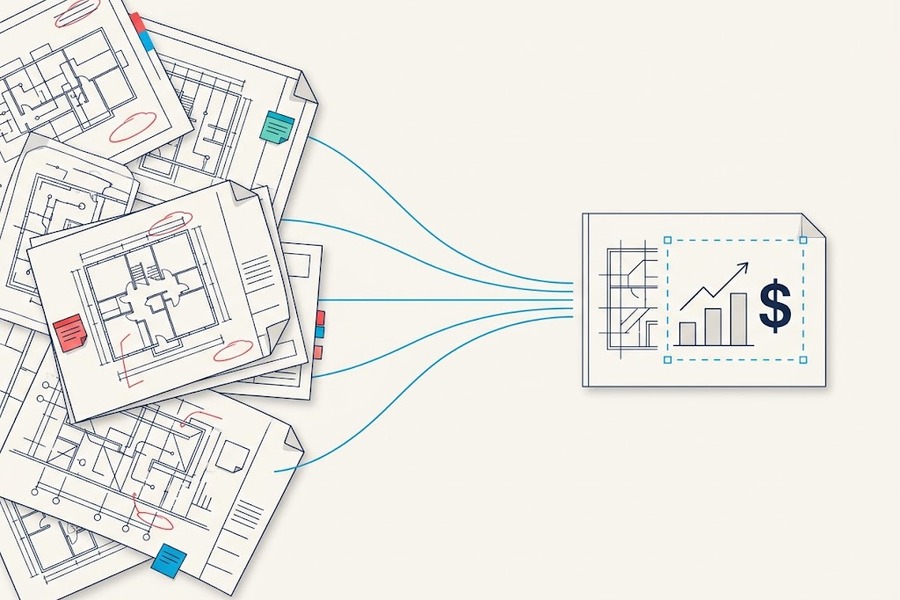
On Monday, someone from the office hands him a laptop. There’s software on it he’s heard of but never opened. A project manager mentions, in passing, that the drawings for the next data center job are already loaded. Somebody (he’s not sure who) will show him how to use it. Eventually. Right now everyone’s running two jobs behind schedule and there’s a design change that just came through on a fourth-floor mechanical room.
He nods, takes the laptop home, and by Wednesday he’s watching YouTube tutorials at 10 p.m., trying to figure out how a takeoff works before the shop starts fabricating on Monday.
This isn’t a story about a contractor who won’t adopt technology.
It’s a story about an industry that keeps insisting the problem is willingness while the people doing the work are just trying to find enough oxygen to breathe.
The most-repeated line in the industry
Every conference opens with it. Every consulting deck features it. Every LinkedIn think piece leans on it.
Construction is slow to adopt technology.
The line has data behind it. McKinsey’s 2024 update to its landmark construction productivity research found that global construction productivity grew just 0.4% annually from 2000 to 2022, compared to 2 percent for the total economy and 3% for manufacturing. Construction firms historically spent less than 1 percent of revenues on IT, less than a third of what automotive and aerospace spent. The gap is real. It isn’t going away on its own.
How the gap gets explained is where the industry has gotten lazy. Contractors are traditional. Culturally resistant. Slow to change. Get them to see the light and adoption will follow. Buy the software. Attend the demo. Read the case study.
That story doesn’t survive contact with what contractors say the moment nobody hands them a multiple-choice answer.
Read what they wrote
In January, 303 MEP contractors sat in a conference room in Austin and answered questions in real time on their phones. Alongside the multiple-choice items were open-ended prompts, space for contractors to say in their own words what was really breaking their business. Their answers became the MEP Innovation Report 2026.
Across 532 open-ended responses, zero contractors said the industry should slow down on technology. Not one argued the old way was better. Not one pushed back against innovation on principle.
What they wrote instead sounded like this:
- “Rate of change. Too fast for users to adopt effectively.”
- “Adoption is a pain point.”
- “Success implementing Stratus in the shop. Obstacle: implementation in the field.”
- “Acceleration in schedules while design is lagging behind.”
These aren’t the words of an industry that wants the world to stand still. They’re the words of an industry, rather, sprinting and being asked to sprint faster, with fewer experienced people, against tighter deadlines, on drawings that aren’t done yet.
Nobody in these responses is asking for less technology. They’re asking for enough air to use the technology they already bought.
This isn’t just a construction problem
BCG’s research on AI adoption offers what might be the cleanest formulation. Seventy percent of the value in any digital initiative comes from people and process. Twenty percent comes from technology and data. Ten percent comes from the algorithm itself, the thing everyone spends most of their time talking about. Seventy-four percent of the companies BCG surveyed had yet to show tangible value from their use of AI. The technology worked fine.
The most vivid proof came from an operating room. In 2009, a study in the New England Journal of Medicine introduced a 19-item surgical safety checklist into eight hospitals around the world. Major complications fell from 11% to 7%. Inpatient deaths fell from 1.5% to 0.8%, a drop of more than 40%. No new technology. No new equipment. Just a documented process that everyone in the room followed.
Construction hasn’t figured this out yet. MEP contracting is where the gap shows up the sharpest.
The number that should change the MEP conversation
Back to the 303 contractors in Austin.
Fifty-one percent said their documented business processes were not sufficient. Only 5% said they were fully documented.
Hold onto that 5% for a second.
Nineteen out of every 20 MEP contractors in the room, firms with full order books, sophisticated tools, leadership teams thinking seriously about VDC, BIM and AI, don’t have the documented workflows that would let a new hire, a new crew or a new tool plug into how the company ultimately works.
Before anyone dismisses this as a small-shop problem, look at the cross-tab. Among the smallest firms surveyed, those with fewer than 20 employees, 60% reported inadequate process documentation. Among the largest, firms with more than 1,000 employees, 46% said the same. A 15-person shop and a 1,500-person shop, dealing with the same problem. That shows up whether you’re doing takeoffs on a strip mall or a hyperscale data center.
Why the resistance story keeps getting told
Because it’s easy.
If contractors are the problem, the solution is more pitching; more demos; better case studies; and sharper ROI calculators. That playbook has been running for a decade. It hasn’t worked because it was solving the wrong problem.
There’s a name for what’s really happening. Change management research firm Prosci calls it “change saturation,” the point at which the volume of change an organization is being asked to absorb exceeds its capacity to absorb any of it. More than 73% of respondents in Prosci’s most recent research said their organizations were near, at or beyond that point.
A 2023 Harvard Business Review article put numbers on the collapse. Employee willingness to support enterprise change fell from 74% in 2016 to 43% in 2022. The average employee faced 10 planned enterprise changes in 2022. In 2016, it was two.
Contractors aren’t different from workers in any other industry. They’re just further along the same curve, dealing with all the same fatigue, plus a labor shortage, plus incomplete designs, plus schedules that were locked in before they walked in the door.
You can’t persuade your way past a calendar that’s already full. A great pitch to a contractor with no bandwidth to absorb it isn’t a missed sale. It’s a missed signal.
MEP is at the epicenter
Labor is thinning out. Designs land half-finished. Field teams adapt to information that isn’t ready, then absorb the rework when it changes. Supervisors stop planning because they’re too busy correcting. Every marked-up drawing that must be re-issued in the field, every clash resolved in real time, every RFI that sits open for another week — that’s a contractor spending capacity they don’t have on friction that shouldn’t exist.
The pressure is worse because the demand is enormous. Dodge Construction Network reported that commercial construction planning was up 37.2% year-over-year in April. Strip data centers out and the number drops to 5.8%. Meanwhile, AGC of America’s 2026 outlook found that 82% of firms are struggling to fill hourly craft positions, a higher share than at any point in the past three years.
Enormous demand. Compressed schedules. No bench to draw from. That’s the capacity trap.
What building capacity looks like
This is where the story turns.
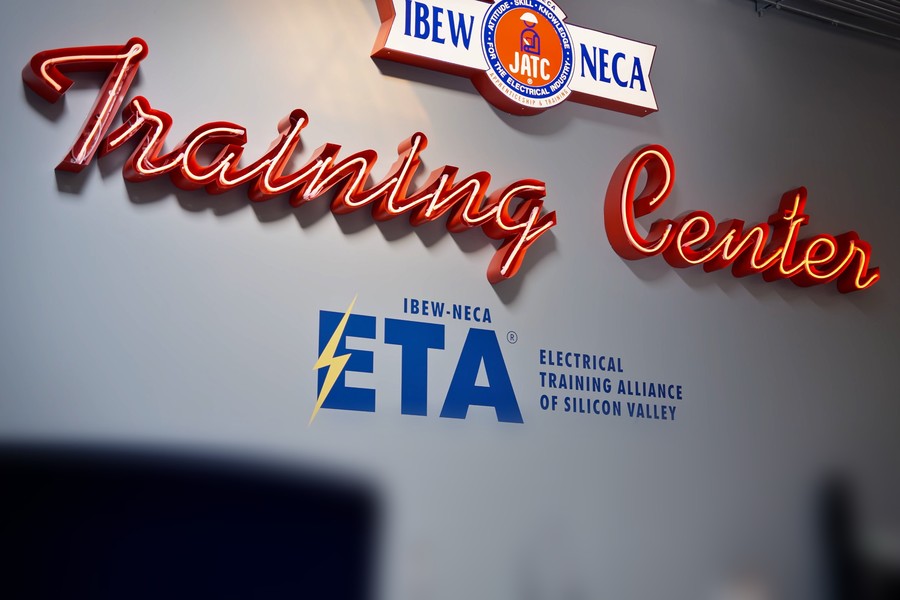
In Santa Clara County, California, the largest electrical apprenticeship program in Northern California is doing something transformative. The Electrical Training Alliance of Silicon Valley (ETASV), jointly managed by IBEW Local 332 and the NECA Santa Clara Valley chapter, trains an average of 600 students and has built two Bluebeam courses into its curriculum. One assumes zero prior software knowledge. The other hands students a working tool set built over years of real jobsite use and teaches them to design real projects with it.
Chris Paup, who built the fundamentals course and now serves as a business representative for IBEW Local 332, wrote most of it while deployed overseas with the California Air National Guard. Free hours between duty shifts, testing early lessons on the service members around him. When he got back and put 20 students in front of the material, he says the first thing he learned was how much he’d have to change.
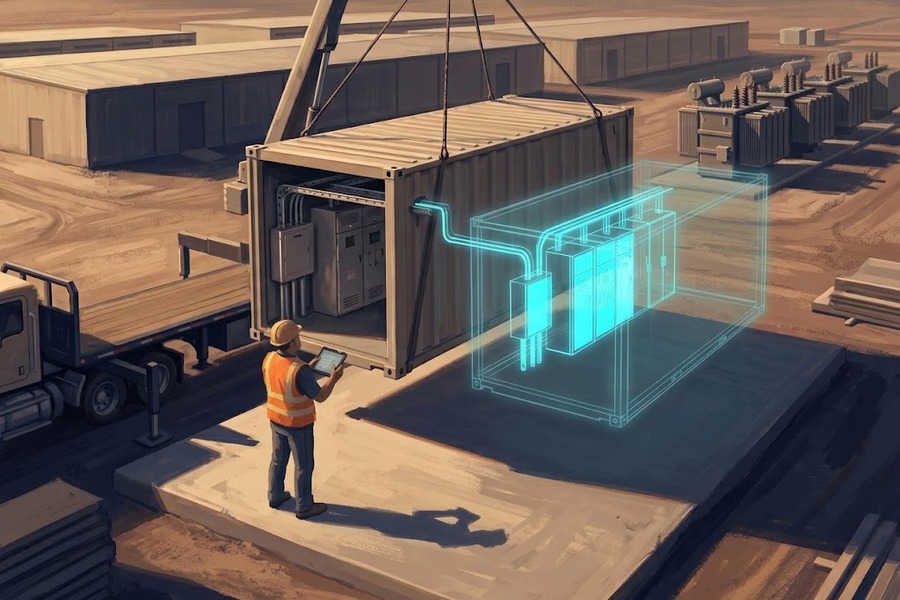
The result: union electricians who show up on data center jobsites already digitally fluent. Not learning on the fly. Not being handed a laptop at 10 p.m. on a Wednesday. Ready.
“That’s when you see them showing up 45 minutes early, an hour early,” Paup says, describing the moment students stop learning the software and start bending it to their own problems. “Because they’ve been thinking all day about how they can do this and they can’t wait to get to the classroom to try it.”
The full story of what ETASV is doing is coming to BUILT soon. It’s worth reading in full, not just as an example of the capacity building this report keeps pointing to, but because it suggests where the industry’s answers might ultimately come from: the training centers, union halls and apprenticeship programs doing the work while everyone else argues about resistance.
The real work ahead
One more thing worth noting. The MEP Innovation Report found that only 17% of contractors describe AI as active in any workflow beyond pilots. The most common description of the industry’s relationship with AI, chosen by 20% of respondents, was “it’s complicated.” That’s not skepticism, just honesty. But the tools don’t care. AI-powered design review, automated markup, drawing comparison, natural-language workflow prompts are already shipping. Every one of the pressures above is now on a shorter clock than it was last year.
The MEP industry that shows up in this data isn’t stuck in the past. It’s ambitious, capable and increasingly well-equipped. What it doesn’t have is room — room to plan, to train, to implement the tools that could make the next 24 months easier instead of harder.
The firms that move fastest over the next two years won’t be the ones that buy the most software. Instead, they’ll be the ones that figure out how to create enough organizational stability, in enough parts of the business, for long enough, to let new ways of working take root.
That’s harder than buying tools. There’s no purchase order for protected planning time. There’s no vendor selling a Tuesday afternoon where nobody is firefighting. Those are the things that separate the firms that pull ahead from the firms that never quite catch up. At Bluebeam, we’re publishing this series because we think the industry is ready to have the harder conversation. The one about conditions, not tools.
The real work ahead is building the room to do it.
This is the first in a four-part BUILT series on the MEP Innovation Report 2026, produced in partnership with MCAA, NECA and SMACNA. Upcoming posts examine the growth paradox, the technology-to-process gap and what MEP contractors are saying about AI.