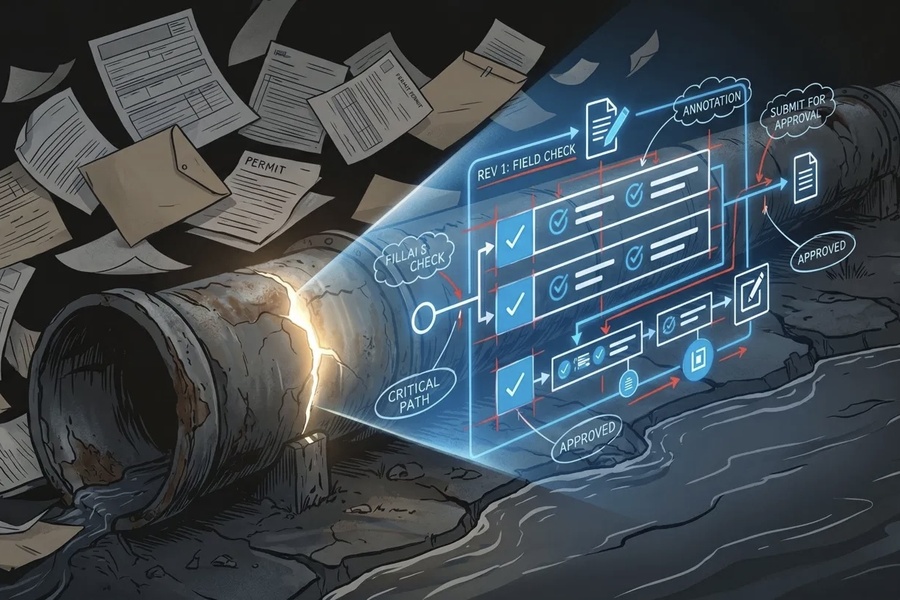
In January, a corroded section of the Potomac Interceptor sewer line burst in the Maryland suburbs of Washington, sending more than 240 million gallons of raw sewage toward the river — one of the largest such spills in U.S. history.
D.C. Water had wanted to reinforce that stretch of pipe for years, but the federal environmental review it needed dragged on well past a one-year deadline set in 2020, as a Washington Post investigation later documented. The pipe burst before the review was finished.
This spring, the New York Times Editorial Board used that story to make a case for permitting reform. The editors called for centralized oversight of transmission lines, binding timelines for environmental reviews and a congressional deal that speeds up infrastructure approvals without gutting environmental protections.
All good ideas. All politically hard.
All likely to take years.
Still, here’s what the Times missed: even if Congress passed permitting reform tomorrow, most public agencies would still be drowning.
Because the bottleneck is an operational problem that extends beyond what any regulation can accomplish.
I spent four years at the Office of Management and Budget watching federal agencies struggle with permitting timelines. Before that, I spent six years as an economist at the Bureau of Labor Statistics, building the data systems that agencies rely on to track what’s happening. I know what operational data looks like when it’s working and what it looks like when it isn’t.
At OMB, the delay was rarely the environmental analysis. Instead, it was version confusion, siloed reviews and comment reconciliation that nobody had ever properly resourced. That’s operational debt, and it accumulates quietly for years until a sewage line bursts. The good news is it doesn’t require an act of Congress to fix, just someone with the authority to look at the workflow honestly and decide that the status quo is no longer acceptable.
Federal environmental impact statements take an average of 3.8 years from start to finish. The Council on Environmental Quality’s own data shows that the gap between completing a final environmental review and issuing a decision averages 5.3 months — more than five times the 30-day regulatory minimum.
CEQ attributes that gap to “factors other than regulatory requirements.” In other words: administrative drag, not the environmental analysis itself.
We at Bluebeam work with hundreds of public agencies, and we’ve seen what happens when they stop doing the stupidest parts of their job. The results aren’t incremental.
Detroit went from issuing 3,000 permits a year to 7,500 — a 150% jump. Pleasanton, Calif., quadrupled per-reviewer capacity. Chicago’s Department of Transportation saved $24 million in 2022 by fixing utility coordination workflow.
What permitting looks like
Start in Las Vegas, 2018. The city handles more than 15,000 plan reviews a year. Before digital transformation, a customer walked in with two or three rolls of plans. A technician created a project number, manually stamped it on the plans and added a physical tag for tracking. Plans got checked into the system and stored in an “active” repository.
When a plans examiner was ready to review, they emailed the administrative staff with the plan number. The examiner physically walked to the repository. Staff retrieved the plans and logged them out. The examiner took the plans back to their desk, marked them up and returned them. Staff checked the plans back in, stored them again and waited for the next reviewer.
“Typically, we would have at least three to four different departments reviewing the plan and following this process,” Yolanda Palomo, process review coordinator for the city of Las Vegas, told Bluebeam.
That’s not 1985. That’s 2018.
Now zoom out. Seattle, same year. The city’s 430-person building department permits about $4 billion in construction annually.
Their review process didn’t use paper plans — but it wasn’t much better. Reviewers opened a submitted plan, then opened a separate text file to write corrections. Every comment went into that text file. When finished, an automated email sent the text file as an attachment. The applicant had to cross-reference the two documents to figure out what needed fixing.
It was siloed. Two digital documents that had to be manually reconciled. Version confusion was constant.
South Carolina, 2014. The state Department of Transportation launched a design-build team to accelerate infrastructure delivery. Yet their review workflow was killing that speed advantage. Reviewers submitted individual comments on separate forms sent via email. No centralized markup. No way to see what other reviewers had said.
“It was essentially like a relay race, where the baton is passed from the designer to the contractor,” Brooks Bickley, assistant program manager with the South Carolina Department of Transportation, told Bluebeam.
Where the time goes
When the Council on Environmental Quality publishes data showing environmental reviews averaging 4.5 years between 2010 and 2018, what does that time consist of?
A lot of it isn’t analysis, so much as coordination. CEQ’s own E-NEPA Report to Congress lays this out: agencies maintain “isolated, non-interoperable software systems.” Applicants submit the same data to multiple agencies. There are no common data standards; the public uses multiple platforms to track a single project.
Translation: agencies are spending months reconciling comments from different reviewers, chasing down the person who has the one marked-up copy, restarting review cycles because someone was working off version 2.3 when version 2.5 was current.
An Oregon Department of Transportation study of 12 highway projects found the strongest statistical correlation wasn’t between project complexity and timeline, but between the number of comment letters from state and federal agencies and the time to get from draft to final review.
More agencies commenting meant more time reconciling conflicting feedback, not necessarily more time analyzing environmental impacts.
A Federal Highway Administration survey of 89 long environmental reviews found the top delay drivers were lack of funding (18%), local controversy (16%), low priority (15%) and complex projects (13%).
Staffing and communication problems showed up in 42% of projects. These are workflow problems.
North Carolina saw this firsthand. Before implementing electronic plan review, the state’s multi-discipline reviews took weeks. After digitizing, North Carolina measured a 39% increase in productivity, not because they hired more staff or cut corners on compliance, but because they stopped losing time to coordination friction.
Las Vegas saw the same thing. Under the old paper system, plans could only be reviewed one discipline at a time — a week or more per discipline, across at least five departments. Printed mylars then had to be routed to five utility companies for final signatures, a process that took up to six weeks.
Then COVID hit.
The fix nobody’s talking about
March 2020. Every public agency in the country goes remote overnight. In most places, that would have been a disaster. Las Vegas, however, like the culture of the city itself, didn’t miss a beat.
“From my perspective, I don’t think we had any downtime due to COVID-19, other than the time that we waited to get laptops,” one city official told Bluebeam at the time.
Zero downtime, during a pandemic, for a department handling more than 15,000 plan reviews a year.
The city had replaced paper plans with digital files. Sequential review with concurrent review — multiple disciplines marking up the same plan at the same time. Physical repositories with cloud storage. Email attachments with real-time collaboration.
The regulatory requirements didn’t change. Las Vegas was still doing plan review, still checking compliance, still coordinating across departments. They just stopped doing it stupidly.
The results: eight-step paper process cut to four steps; $600,000 saved annually; reviews that used to take weeks now take days.
South Carolina cut design review time by 50%.
Detroit’s Buildings, Safety Engineering and Environmental Department went from issuing 3,000 permits a year to 7,500, supporting roughly $5 billion in development in 2023. Chief Building Official James Foster told Government Technology: “I can’t imagine how we would have been able to handle all of this if plan review were still on paper.”
Pleasanton’s Building Division saw per-reviewer plan checks go from 25 to 30 per month to roughly 100, nearly quadrupling capacity. Chief Building Official Robert Queirolo: “A plan check that might have taken six hours the old-fashioned way now takes a few hours.”
Chicago’s Department of Transportation implemented better utility coordination workflow and saved $24 million in 2022. They cut underground utility hits from the national average of 1.67 per 1,000 to 0.49.
Seattle ditched the separate text-file approach and moved to inline markup. In the first six months of 2022, the city approved 20% more complex construction permits than the previous six months. “The quality of communications was so high in our new system that we’re doing more volume — we are getting to ‘approved’ faster,” one city official told Bluebeam at the time.
What this means for infrastructure
The TransWest Express transmission line took 18 years to win final approval — not because anybody opposed clean energy, but because coordinating across jurisdictions, agencies and landowners is a nightmare.
That’s the same workflow problem Las Vegas had. The same coordination friction South Carolina faced. The same version confusion Seattle dealt with.
Policy reform matters. The SPEED Act, which passed the House in December 2025 and now sits before the Senate Environment and Public Works Committee, would streamline NEPA timelines and limit litigation windows. That would help.
But if your review process is still running on email attachments and paper round-trips, all the policy reform in the world won’t save you. You’ll just be doing bad workflow faster.
The emergency repair on the Potomac line is done and the water has cleared, but the cleanup has already run past its $20 million estimate — and the permanent fix still has to clear another round of environmental review, the same process that was too slow the first time.
Maybe Congress passes the SPEED Act. Maybe lawmakers broker a bipartisan deal. Maybe they don’t.
Yet while we wait, there are cities approving permits twice as fast because they stopped mailing PDFs and started marking them up in real time.
There are state departments of transportation cutting review cycles in half because reviewers can finally see each other’s comments.
There are public agencies that didn’t lose a single day during COVID because their workflow wasn’t dependent on paper.
It’s not sexy, and it won’t make the editorial page of the New York Times. But it’s the kind of infrastructure fix that doesn’t require a bill — just a willingness to look at how you’re really spending your time and admit that some of it is waste.
The permitting crisis is real. The Times is right about that.
But the fix isn’t just in Washington. Some of it is sitting in your own workflow, waiting for someone to finally admit it’s broken.
Parth Tikiwala is head of government affairs at Bluebeam and head of global public sector for the Nemetschek Group. He previously served as acting director of technology modernization and data at the U.S. Office of Management and Budget, Executive Office of the President.