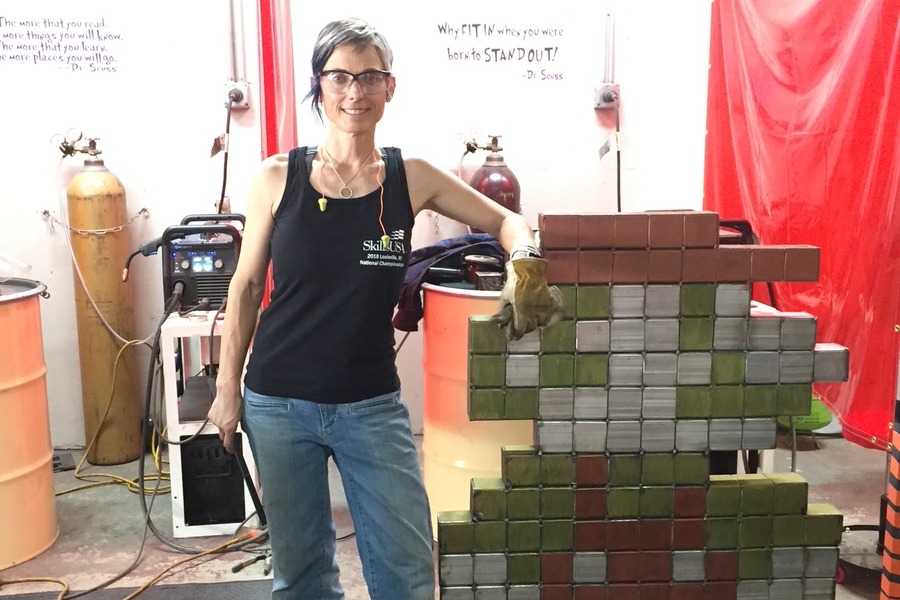
On the show floor at FabTech, a young woman charged at Shanen Aranmor, a certified welding inspector, giving her a huge hug. Aranmor didn’t recognize the woman, but the woman recognized Aranmor. The young woman explained she saw Aranmor present at a SkillsUSA competition years earlier and it changed her. Sitting in a room full of men, spotting one woman, and one in a position of authority, made this young woman believe she belonged in that room too.
The moment caught Aranmor off guard. She’d never had a female mentor in welding. None of the women she works with in the industry had either. “It didn’t occur to me that representation mattered,” she said. “We didn’t have it, so we didn’t know what it could do for somebody.”
So, her first project wasn’t a trade school or a workforce pipeline. It was establishing Weld Like a Girl, where she uses welding as the vehicle that helps people blast through limitations.
From the Junk Drawer to the Welding Booth
Aranmor was the kind of kid who would dump out her grandmother’s junk drawer and try to make things from the random collection of hardware and odds and ends. She loved her metal shop class in junior high and was the first girl in her school to take Metal Shop 2. When she won her junior high graduation award for metal shop, she accepted it in a skirt and heels.
Her high school didn’t offer metal shop, and she drifted away from metalwork. She became a licensed therapist, working with sexually abused children and their families. The work was meaningful and emotionally brutal.
Aranmor became a college professor in psychology and wellness and moved to college administration. She found herself in a world she describes as angry. From students to faculty to administrators and staff, everyone was angry at someone. She needed an outlet to manage her stress. She landed on blacksmithing. “You take a piece of metal, you stick it in a hot forge, and you can pound the crap out of it, and no one knows what you’re saying because you’re all wearing hearing protection,” she said. “It is seriously therapeutic.”
Blacksmithing also reignited her love of metalwork. When the blacksmithing professor announced his class was being discontinued, Aranmor volunteered to fill in. The head of the welding department agreed on one condition: she had to take a welding class first. Her first day in class, something clicked. “I think I understand addiction,” she said. Her immediate next thought was “we have to do this as a women’s empowerment workshop.”
Proving It Every Damn Day
That goal would have to wait. Aranmor spent six years as a certified welding trainer for Miller Electric, working as the company’s first woman trainer and one of only five trainers across North America.
At a training session in Portland, a man walked in on the first day and asked her, “Hey, toots. Can you get the teacher for me?” Aranmor stepped into the shop, steadied her breath, then walked out at eight o’clock, wrote her name on the board and got to work. During the day, that man peppered her with basic questions, testing her. He finally asked one she couldn’t answer. During a break, she researched the question and shared the answer with the class. “The feeling is, as a woman in the industry, you have to prove yourself every damn day,” she said. “Eventually you start getting repeat students. But then the next person comes in, and it starts over. Every damn day.”
During her time at Miller, she kept asking her boss to let her run women’s welding workshops in the communities she visited. The answer was always the same: it’s not in your job description. So, she made it her job description. The last time she asked and was told no, she gave her notice and launched Weld Like a Girl.
Welding as the Doorway
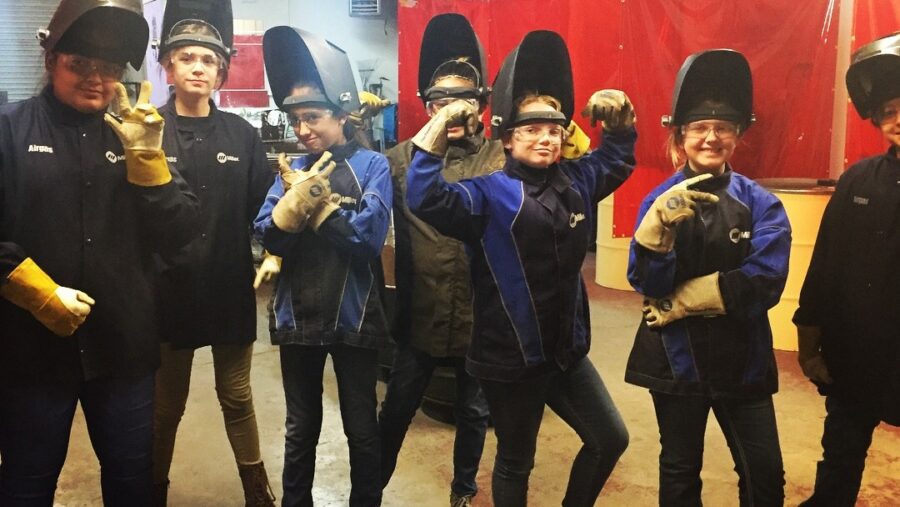
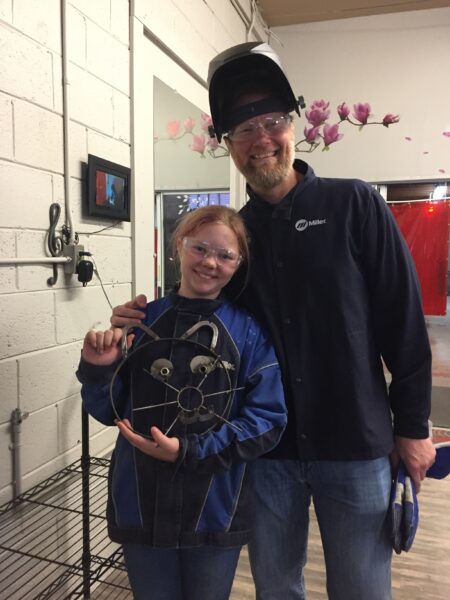
Weld Like a Girl was never designed to be exclusively for women. Even before Aranmor had a physical shop, men and boys in the community expressed interest in learning welding too. So, the workshops are open to everyone. She runs themed classes where participants make everything from yard art to Minions welded from old helium cylinders.
Through Weld Like a Girl, Aranmor has taught participants as young as 5 and as old as 88. Second graders walk over from a nearby charter school twice a year. On one visit, they add a weld to a group sculpture. On the second, they build their name out of nuts and bolts to take home.
She tells her participants, “If you do something here that you didn’t think you could do and you succeed, what are you going to be able to accomplish now?”
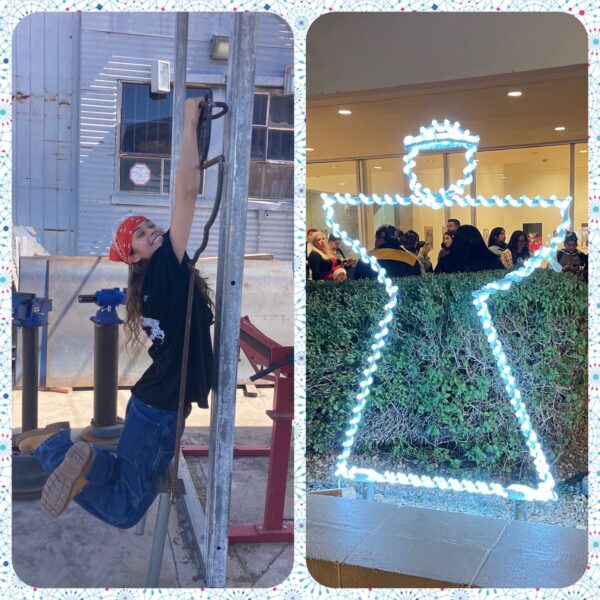
The group also works with local charter high schools, one of which is connected to the juvenile courts. Together with Aranmor, students designed and fabricated a large-scale welcome installation for the Yuma civic center: a water tower and a patchwork car the students built from fabricated and vintage car parts.
Months after the unveiling, one of the students called her. He told her he’d been driving past “our sculpture” on his way somewhere he shouldn’t have been, and he turned around. Aranmor told him that any time he’s tempted to make a bad choice, he should go sit in front of that sculpture and think. The city paved a road in front of it and wired it with solar-powered headlights. “It’s a place you could go sit at and think about your life choices,” Aranmor says.
She’s also brought Weld Like a Girl workshops to domestic violence survivors and Special Olympians. When someone hesitates at the booth, Aranmor flips the script. “I can teach an 88-year-old,” she tells them. “Are you doubting me?” It shifts the weight off their insecurity and lets them lean on her confidence. The mood lightens and they pick up the torch.
Opening the Next Door
In February 2026, Aranmor launched Welder Corps, a new program geared toward veterans and their families. She kept the pilot class small: five participants, ranging from an 11-year-old homeschooler to a retired Army veteran who decided, in his 80s, that he wanted to learn to weld.
Her program uses the National Center for Construction Education and Research (NCCER) curriculum, starting with a core class where participants can earn a wallet card certifying jobsite readiness. Participants can take all seven NCCER units or go piecemeal.
Her other group in pilot is Future Welding Inspectors where she teaches groups of 10- to 17-year-olds to identify good and bad welds using challenge cards and gamification. As a certified welding inspector, she wants the group to be a pipeline creating more certified welding inspectors. Her goal is to develop a full curriculum with interactive and digital components.
More Than Welding
Across all of Aranmor’s projects, Weld Like a Girl, Welder Corpsand Future Welding Inspectors, the common thread isn’t welding. Welding is the tool to build a wellness that comes when people believe they can do more than they thought. She uses metalwork to crack open that door: a new skill, a public sculpture, a credential or even just a single weld that didn’t seem possible the day before. What happens next is theirs to decide.
Her message is the same whether she’s working with a domestic violence survivor, a transitioning veteran or a second grader holding a welding torch for the first time. “People need to know that they’re enough,” she said. “They’re enough.”